Part 3 03 — The Trial and Passion of Jesus
The Trial and Passion of Jesus
Section titled “The Trial and Passion of Jesus”(18:1–19:42)
John 18–19 recounts the arrest, trials, and crucifixion of Jesus Christ. These events unfold amid betrayal and injustice, yet they occur within God’s sovereign plan. Through the cross, Christ fulfils Scripture and secures redemption. His blood shed on the cross became the basis of salvation. These chapters highlight divine purpose and the victory of grace over human sin.
John 18
Section titled “John 18”John 18 is divided into two sections: the arrest of Jesus and His interrogation by the high priest. These passages highlight the events leading to His trial and the unfolding of God’s redemptive plan.
Places and People Profile
Section titled “Places and People Profile”Places Profile
Section titled “Places Profile”- Kidron Valley: A brook running north to south on the east side of ancient Jerusalem. It separated the Temple area from the Mount of Olives. The site of the Garden of Gethsemane is thought to be just west of the Kidron Valley on the way to Bethany.
People Profile
Section titled “People Profile”- Annas: Served as high priest from AD 6 to 15. He also had four sons and a son-in-law who served, including Caiaphas, who was high priest from AD 18 to 36.
- Pilate: Appointed governor by Emperor Tiberius in AD 26 and held the post for ten years. He experienced difficult relationships with the Jewish population in Palestine. He was finally deposed in AD 36 by Vitellius, governor of Syria, and sent to Rome.
The Betrayal and Arrest of Jesus (18:1–11)
Section titled “The Betrayal and Arrest of Jesus (18:1–11)”Betrayal and Arrest of Jesus
¹ When Jesus had spoken these words, he went out with his disciples across the brook Kidron, where there was a garden, which he and his disciples entered. ² Now Judas, who betrayed him, also knew the place, for Jesus often met there with his disciples. ³ So Judas, having procured a band of soldiers and some officers from the chief priests and the Pharisees, went there with lanterns and torches and weapons.
⁴ Then Jesus, knowing all that would happen to him, came forward and said to them, “Whom do you seek?” ⁵ They answered him, “Jesus of Nazareth.” Jesus said to them, “I am he.” Judas, who betrayed him, was standing with them. ⁶ When Jesus said to them, “I am he,” they drew back and fell to the ground. ⁷ So he asked them again, “Whom do you seek?” And they said, “Jesus of Nazareth.” ⁸ Jesus answered, “I told you that I am he. So, if you seek me, let these men go.” ⁹ This was to fulfill the word that he had spoken: “Of those whom you gave me I have lost not one.” ¹⁰ Then Simon Peter, having a sword, drew it and struck the high priest’s servant and cut off his right ear. (The servant’s name was Malchus.) ¹¹ So Jesus said to Peter, “Put your sword into its sheath; shall I not drink the cup that the Father has given me?”
Heading for Garden of Gethsemane (v. 1)
Section titled “Heading for Garden of Gethsemane (v. 1)”The Farewell Discourse is now complete. Jesus and His disciples cross the Kidron Brook to reach the Garden of Gethsemane. A series of events follows until early morning.
JOHN 18 NARRATIVE CHART
| Event | Location | Verses | Key Summary |
|---|---|---|---|
| The Arrest | Garden of Gethsemane | 1–11 | Jesus identifies himself; guards fall; Peter cuts off Malchus' ear. |
| First Inquiry | House of Annas | 12–14 | Jesus is bound and taken to the former High Priest. |
| First Denial | High Priest's Gate | 15–18 | Peter is questioned by the girl at the door while John enters. |
| Religious Trial | Inner Court | 19–24 | Annas questions Jesus' teaching; Jesus is struck by an official. |
| Final Denials | By the Fire | 25–27 | Peter denies Jesus two more times; the rooster crows. |
| The Roman Trial | The Praetorium | 28–32 | Jewish leaders bring Jesus to Pilate but refuse to enter the building. |
| Pilate's Inquiry | Inside Praetorium | 33–38a | Pilate questions Jesus on his kingship: "What is truth?" |
| The Release | Outside Praetorium | 38b–40 | Pilate finds no guilt; the crowd chooses the robber Barabbas. |
Betrayal and Arrest of Jesus (vv. 1–11)
Section titled “Betrayal and Arrest of Jesus (vv. 1–11)”Jesus’ betrayal and arrest occur as He enters the garden, fully aware of what lies ahead (v. 1). He knowingly walks toward the approaching soldiers and officers sent to arrest Him, demonstrating His willing submission to the Father’s redemptive plan (vv. 2–3). He identifies Himself as “I am” (v. 5).
Judas’ act represents the height of human betrayal, yet Jesus’ response demonstrates His sovereign authority and divine purpose (vv. 4–6). He identifies Himself and steps forward, exposing the powerlessness of those sent against Him (vv. 7–9). When Peter strikes the high priest’s servant, Jesus immediately rebukes him, emphasising that His mission will be fulfilled without violence and that obedience to God’s will surpasses all human defence (v. 10).
This passage underscores Jesus’ divine authority, the certainty of His suffering, and the fulfilment of Scripture through His willing submission to arrest.
Jesus Questioned by the High Priest, Denied by Peter (18:12–27)
Section titled “Jesus Questioned by the High Priest, Denied by Peter (18:12–27)”Jesus Faces Annas and Caiaphas
¹² So the band of soldiers and their captain and the officers of the Jews arrested Jesus and bound him. ¹³ First they led him to Annas, for he was the father-in-law of Caiaphas, who was high priest that year. ¹⁴ It was Caiaphas who had advised the Jews that it would be expedient that one man should die for the people.
Jesus’ Trial before Pilate
Section titled “Jesus’ Trial before Pilate”Raymond Brown has described the “inside-outside” structure of the trial of Jesus before Pilate.³ He identifies seven scenes that alternate between the interior of the praetorium and the exterior courtyard. Moreover, he observes a chiastic structure in these seven scenes. Scenes one and seven, two and six, and three and four are parallel with one another, while the fourth scene is pivotal. He identifies the scenes as follows:
Jesus Faces Annas and Caiaphas (vv. 12–14)
Section titled “Jesus Faces Annas and Caiaphas (vv. 12–14)”After His arrest, Jesus is brought before Annas, the former high priest and father-in-law of Caiaphas (v. 13).
John combines the religious trial with Peter’s denial. He moves the narrative back and forth between Jesus, Annas, and Peter in the courtyard. The narrative contrasts Jesus’ composed authority and steadfast obedience to God’s plan with Peter’s human weakness and fear, revealed in his denial (vv. 15–17).
After His arrest, Jesus is first brought before Annas, the influential former high priest (v. 12), and then sent to Caiaphas, the current high priest (v. 13), where the religious leaders are already assembling. John emphasises the calculated nature of these proceedings, as the leaders seek to secure evidence for His condemnation, highlighting the conspiratorial and unlawful character of their actions (v. 14).
Caiaphas’ position as high priest becomes pivotal, for his prophecy that Jesus must die for the nation (11:49–52) is now moving toward fulfilment (v. 14). Jesus’ calm and composed presence contrasts with the scheming of the authorities, illustrating His sovereignty even under human judgment (v. 14).
Peter Denies Jesus
¹⁵ Simon Peter followed Jesus, and so did another disciple. Since that disciple was known to the high priest, he entered with Jesus into the courtyard of the high priest, ¹⁶ but Peter stood outside at the door. So the other disciple, who was known to the high priest, went out and spoke to the servant girl who kept watch at the door, and brought Peter in.
¹⁷ The servant girl at the door said to Peter, “You also are not one of this man’s disciples, are you?” He said, “I am not.” ¹⁸ Now the servants and officers had made a charcoal fire, because it was cold, and they were standing and warming themselves. Peter also was with them, standing and warming himself.
Peter’s First Denial of Jesus (vv. 15–18)
Section titled “Peter’s First Denial of Jesus (vv. 15–18)”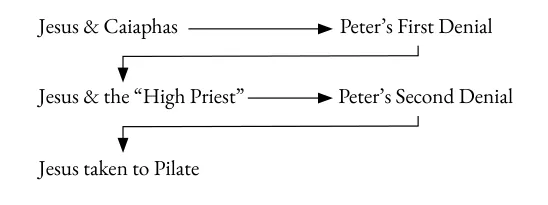
After Jesus’ arrest, Peter follows at a distance with another disciple. This disciple is known to the high priest (v. 15). Because of this connection, the other disciple gains access to the high priest’s courtyard, while Peter stays outside (v. 16).
Inside, a servant girl questions Peter, “You also are not one of this man’s disciples, are you?” Peter denies any association with Jesus, saying, “I am not” (v. 17). Nearby, a charcoal fire warms the servants and officers, and Peter stands with them, blending into the crowd (v. 18).
Peter’s denial shows how fear can override loyalty, even in the most devoted followers. The narrative reminds us that true discipleship requires the courage to acknowledge Christ openly, rather than seeking comfort in safety and conformity.
The High Priest Questions Jesus
¹⁹ The high priest then questioned Jesus about his disciples and his teaching. ²⁰ Jesus answered him, “I have spoken openly to the world. I have always taught in synagogues and in the temple, where all Jews come together. I have said nothing in secret. ²¹ Why do you ask me? Ask those who have heard me what I said to them; they know what I said.”
²² When he had said these things, one of the officers standing by struck Jesus with his hand, saying, “Is that how you answer the high priest?”
²³ Jesus answered him, “If what I said is wrong, bear witness about the wrong; but if what I said is right, why do you strike me?” ²⁴ Annas then sent him bound to Caiaphas the high priest.
The High Priest Questions Jesus (vv. 19–24)
Section titled “The High Priest Questions Jesus (vv. 19–24)”Annas questions Jesus about His disciples and His teaching (v. 19). He responds calmly, emphasising that His ministry has always been public, explaining that He has spoken openly in synagogues and in the temple, where all Jews could hear Him (v. 20). He invites verification, saying, “Ask those who have heard Me; they know what I said” (v. 21).
One of the officers strikes Jesus for speaking boldly (v. 22), but He replies with measured authority, stating that if He has spoken wrongly, let it be shown. But if rightly, why strike Him (v. 23). Annas then sends Jesus bound to Caiaphas, advancing the process towards the formal trial (v. 24).
This encounter highlights Jesus’ integrity, courage, and submission to God’s plan. While His accusers act violently and unjustly, Jesus remains steadfast, modelling righteousness under pressure.
Peter Denies Jesus Again
²⁵ Now Simon Peter was standing and warming himself. So they said to him, “You also are not one of his disciples, are you?” He denied it and said, “I am not.” ²⁶ One of the servants of the high priest, a relative of the man whose ear Peter had cut off, asked, “Did I not see you in the garden with him?” ²⁷ Peter again denied it, and at once a rooster crowed.
A Rooster Crowed (vv. 25–27)
Section titled “A Rooster Crowed (vv. 25–27)”The pressure increases when a servant of the high priest, a relative of Malchus, the man whose ear Peter had cut off in the garden, directly asks, “Did I not see you in the garden with him?” (v. 26). Gripped by fear, Peter denies knowing Jesus a third time. Immediately afterward, the rooster crows, fulfilling Jesus’ prediction that Peter would deny Him three times before the rooster crowed (v. 27), marking a moment of sudden recognition and regret.
Roosters were common around homes and courtyards in first-century Jerusalem. Their crowing would have been normal, making Jesus’ prediction both realistic and memorable.
John’s concise narrative compresses the three denials into this brief account, emphasising Peter’s fear, human frailty, and the dramatic tension surrounding Jesus’ arrest. The rooster’s crow provides a clear temporal and narrative marker.
Jesus before Pilate (18:28–40)
Section titled “Jesus before Pilate (18:28–40)”Jesus Before Pilate
²⁸ Then they led Jesus from the house of Caiaphas to the governor’s headquarters. It was early morning. They themselves did not enter the governor’s headquarters, so that they would not be defiled, but could eat the Passover. ²⁹ So Pilate went outside to them and said, “What accusation do you bring against this man?” ³⁰ They answered him, “If this man were not doing evil, we would not have delivered him over to you.” ³¹ Pilate said to them, “Take him yourselves and judge him by your own law.” The Jews said to him, “It is not lawful for us to put anyone to death.” ³² This was to fulfill the word that Jesus had spoken to show by what kind of death he was going to die.
The Trial of Jesus Before Pilate (vv. 28–32)
Section titled “The Trial of Jesus Before Pilate (vv. 28–32)”The first-century Roman historian Tacitus confirms the historical reality of Jesus’ execution, stating that:
Christus, from whom the name [Christians] had its origin, suffered the extreme penalty during the reign of Tiberius at the hands of Pontius Pilate, procurator of Judea (Tacitus, Annals 15.44.3).
Early in the morning, Jesus is led from the house of Caiaphas to the governor’s headquarters (v. 28), marking the transition from Jewish to Roman authority in His trial. The Jewish leaders themselves do not enter the praetorium, concerned that they might become ritually defiled before eating the Passover (v. 28).
Pilate steps out to meet them and asks, “What accusation do you bring against this man?” (v. 29). They reply vaguely, claiming, “If this man were not doing evil, we would not have delivered him over to you” (v. 30), offering no specific charge. He points out that, under Jewish law, they have the authority to judge Him themselves, but the leaders respond that they cannot carry out a death sentence (v. 31).
John notes that this transfer to Pilate fulfils Jesus’ earlier prediction about the manner of His death, foreshadowing the crucifixion (v. 32). The passage highlights the procedural and legal dimensions of Jesus’ trial, the contrast between the Jewish leaders’ concern for ritual purity and their moral failing, and the unfolding of events in accordance with Jesus’ own foretelling.
My Kingdom Is Not of This World
³³ So Pilate entered his headquarters again and called Jesus and said to him, “Are you the King of the Jews?” ³⁴ Jesus answered, “Do you say this of your own accord, or did others say it to you about me?”
³⁵ Pilate answered, “Am I a Jew? Your own nation and the chief priests have delivered you over to me. What have you done?” ³⁶ Jesus answered, “My kingdom is not of this world. If my kingdom were of this world, my servants would have been fighting, that I might not be delivered over to the Jews. But my kingdom is not from the world.” ³⁷ Then Pilate said to him, “So you are a king?” Jesus answered, “You say that I am a king. For this purpose I was born and for this purpose I have come into the world—to bear witness to the truth. Everyone who is of the truth listens to my voice.” ³⁸ Pilate said to him, “What is truth?” After he had said this, he went back outside to the Jews and told them, “I find no guilt in him. ³⁹ But you have a custom that I should release one man for you at the Passover. So do you want me to release to you the King of the Jews?” ⁴⁰ They cried out again, “Not this man, but Barabbas!” Now Barabbas was a robber.
Pilate Questions Jesus (vv. 33–40)
Section titled “Pilate Questions Jesus (vv. 33–40)”When Jesus is brought before Pilate, the governor asks, “Are you the King of the Jews?” (v. 33). Jesus replies by asking whether Pilate’s question comes from himself or from others (v. 34), and then clarifies that His kingdom is not of this world (v. 36). If it were, His followers would fight to prevent His arrest, but His kingship operates on a different, spiritual plane (v. 36).
Pilate presses for confirmation, and Jesus affirms that He is a king, yet His purpose is to testify to the truth (v. 37). Pilate, puzzled and frustrated, asks, “What is truth?” (v. 38) and negotiates with the Jewish leaders, eventually releasing Barabbas while condemning Jesus (v. 40).
Preaching and Teaching the Word
Section titled “Preaching and Teaching the Word”God in the Gardens
Both ancient and modern commentators have observed a link between the garden scenes in John’s Gospel and the Garden of Eden in Gen 1–3. Preachers today can thoughtfully compare John’s two garden episodes (18:1–11; 20:11–18) with Gen 2:8–3:24 to explore God’s presence in the garden, His engagement with humanity, and human responses in each setting.
Four Gardens
The Bible presents four significant gardens: the Garden of Eden (Gen 2:8–3:24), the Garden of Gethsemane (18:1–11), the garden tomb (19:41–42; 20:1–18), and the garden in Revelation (Rev 22:1–5).
A preaching framework can follow God’s redemptive plan as revealed in these gardens, progressing from creation to human rebellion, through resurrection, and culminating in ultimate restoration. God’s plan of redemption is revealed in these gardens: what was lost through sin, what was surrendered through Christ’s obedience, and what is ultimately restored in Him.
Courage and Cowardice
The contrast between Jesus’ courage and Peter’s fearfulness is highlighted throughout all four Gospels. This contrast serves both as an encouragement to emulate Jesus’ boldness rather than Peter’s weakness and as a proclamation of God’s power and faithfulness revealed in Christ. This passage is especially suited for preaching on Good Friday or Passion/Palm Sunday.
John 19
Section titled “John 19”John 19 records the crucifixion of Jesus Christ, describing His suffering and death and the fulfilment of God’s redemptive purpose, culminating in His sacrifice for humanity’s salvation and the triumph that paves the way for His resurrection.
Places and People Profile
Section titled “Places and People Profile”Places Profile
Section titled “Places Profile”- Gabbatha: An Aramaic word meaning “height” or “ridge.” This was the judgment seat used by Pilate when sentencing Jesus and may have been part of the Castle of Antonia.
- Golgotha: A Greek word derived from the Aramaic word for “skull.” The Latin equivalent is Calvary. It may have been named for its resemblance to a skull or because it was a place of execution. Its exact location remains a matter of scholarly debate.
People Profile
Section titled “People Profile”- Mary, wife of Clopas: Possibly the mother of James and Joses. She is counted among Jesus’ disciples in Galilee (Luke 8:2–3) and is mentioned also by Matthew (Matt. 27:56) and Mark (Mark 15:40). She witnessed Jesus’ burial (Mark 15:47) and came to the tomb (Mark 16:8).
- Mary of Magdala: The woman from whom Jesus cast out seven demons (Mark 16:9; Luke 8:2). She was a devoted disciple from a town on the southwest coast of the Sea of Galilee. She stood at the cross and followed Jesus’ body to the grave (Matt. 27:61). She was the first person to learn of the resurrection (Matt. 28:1–8; Mark 16:9; Luke 24:1, 10).
- Joseph of Arimathea: A wealthy man and member of the Sanhedrin (Matt. 27:57; Mark 15:43). He was a God-fearer looking for the kingdom of heaven (Mark 15:43; Luke 23:50) and a secret disciple because of fear (John 19:38). He provided his own new tomb for Jesus’ burial.
Jesus Sentenced (vv. 1–16a)
Section titled “Jesus Sentenced (vv. 1–16a)”Jesus Delivered to Be Crucified
¹ Then Pilate took Jesus and flogged him. ² And the soldiers twisted together a crown of thorns and put it on his head and arrayed him in a purple robe. ³ They came up to him, saying, “Hail, King of the Jews!” and struck him with their hands. ⁴ Pilate went out again and said to them, “See, I am bringing him out to you that you may know that I find no guilt in him.” ⁵ So Jesus came out, wearing the crown of thorns and the purple robe. Pilate said to them, “Behold the man!” ⁶ When the chief priests and the officers saw him, they cried out, “Crucify him, crucify him!” Pilate said to them, “Take him yourselves and crucify him, for I find no guilt in him.” ⁷ The Jews answered him, “We have a law, and according to that law he ought to die because he has made himself the Son of God.” ⁸ When Pilate heard this statement, he was even more afraid. ⁹ He entered his headquarters again and said to Jesus, “Where are you from?” But Jesus gave him no answer. ¹⁰ So Pilate said to him, “You will not speak to me? Do you not know that I have authority to release you and authority to crucify you?” ¹¹ Jesus answered him, “You would have no authority over me at all unless it had been given you from above. Therefore he who delivered me over to you has the greater sin.”
¹² From then on Pilate sought to release him, but the Jews cried out, “If you release this man, you are not Caesar’s friend. Everyone who makes himself a king opposes Caesar.” ¹³ So when Pilate heard these words, he brought Jesus out and sat down on the judgment seat at a place called The Stone Pavement, and in Aramaic Gabbatha. ¹⁴ Now it was the day of Preparation of the Passover. It was about the sixth hour. He said to the Jews, “Behold your King!” ¹⁵ They cried out, “Away with him, away with him, crucify him!” Pilate said to them, “Shall I crucify your King?” The chief priests answered, “We have no king but Caesar.”
¹⁶ So he delivered him over to them to be crucified.
After Pilate pronounces judgment (19:1–2), Jesus is handed over to the Roman soldiers, who take Him into the praetorium and mock Him with a scarlet robe and a crown of thorns, sarcastically hailing Him as “King of the Jews” (19:2–3). They strike Him and kneel in derision, highlighting the contrast between worldly power and Jesus’ true, spiritual kingship (v. 3).
Pilate brings Jesus before the crowd and declares, “Behold the man!” (v. 5), but the Jewish leaders continue to call for His execution (v. 6). Though Pilate seeks to release Him, the pressure from the crowd and the religious authorities forces him to deliver Jesus to be crucified.
The passage underscores the cruelty and mockery of human authority. John presents Jesus’ crucifixion as the fulfilment of messianic prophecy and God’s plan.
OLD TESTAMENT PROPHECIES FULFILLED
| # | Prophecy | Reference |
|---|---|---|
| 1 | Mocked and beaten | Isa 50:6 and Ps 22:7–8 (describe the Messiah's suffering and ridicule). |
| 2 | Silent before accusers | Isa 53:7 (portrays the oppressed Servant who does not speak). |
| 3 | Rejected by His people | Ps 69:4 and Isa 53:3 (show the Messiah's rejection, reflected in the crowd choosing Barabbas). |
| 4 | A despised king | Zech 9:9 (points to a humble yet rejected King, seen in the crown of thorns). |
Jesus’ Crucifixion and Burial (19:16b–42)
Section titled “Jesus’ Crucifixion and Burial (19:16b–42)”The Crucifixion
¹⁷ So they took Jesus, and he went out, bearing his own cross, to the place called The Place of a Skull, which in Aramaic is called Golgotha. ¹⁸ There they crucified him, and with him two others, one on either side, and Jesus between them. ¹⁹ Pilate also wrote an inscription and put it on the cross. It read, “Jesus of Nazareth, the King of the Jews.” ²⁰ Many of the Jews read this inscription, for the place where Jesus was crucified was near the city, and it was written in Aramaic, in Latin, and in Greek. ²¹ So the chief priests of the Jews said to Pilate, “Do not write, ‘The King of the Jews,’ but rather, ‘This man said, I am King of the Jews.’” ²² Pilate answered, “What I have written I have written.”
²³ When the soldiers had crucified Jesus, they took his garments and divided them into four parts, one part for each soldier; also his tunic. But the tunic was seamless, woven in one piece from top to bottom, ²⁴ so they said to one another, “Let us not tear it, but cast lots for it to see whose it shall be.” This was to fulfill the Scripture which says,
“They divided my garments among them, and for my clothing they cast lots.”
²⁵ So the soldiers did these things, but standing by the cross of Jesus were his mother and his mother’s sister, Mary the wife of Clopas, and Mary Magdalene. ²⁶ When Jesus saw his mother and the disciple whom he loved standing nearby, he said to his mother, “Woman, behold, your son!” ²⁷ Then he said to the disciple, “Behold, your mother!” And from that hour the disciple took her to his own home.
Jesus Crucified (vv. 16b–27)
Section titled “Jesus Crucified (vv. 16b–27)”The movement of the crucifixion scene goes something like this:⁴
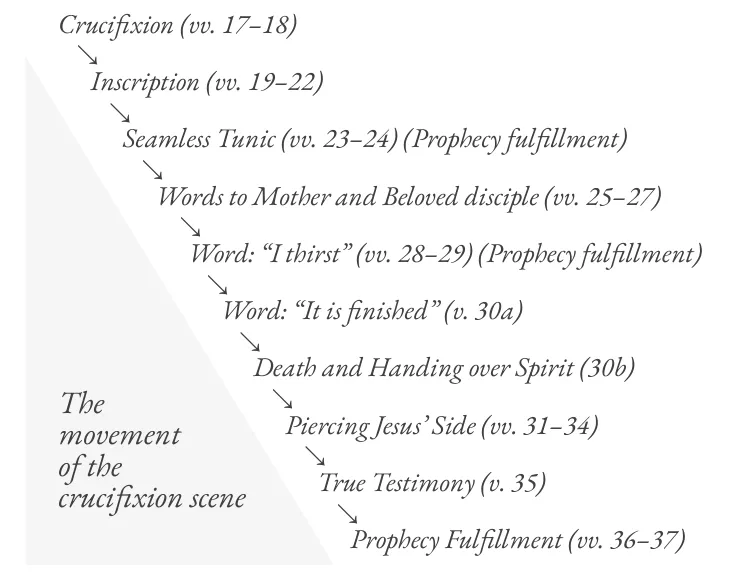
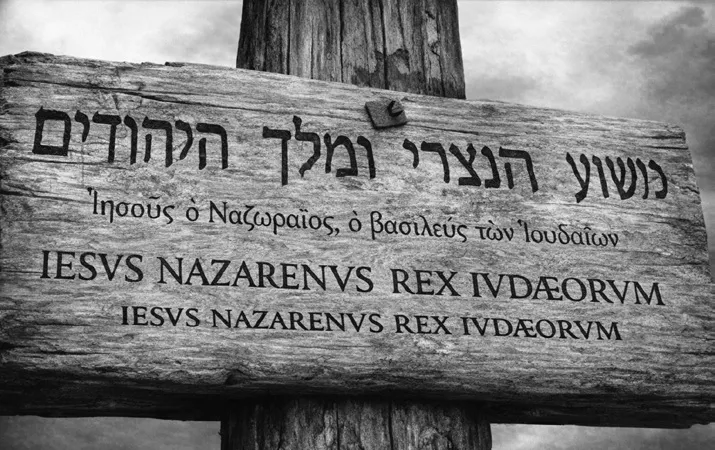
Jesus carries His own cross to Golgotha, the “Place of the Skull” (v. 17), bearing the weight of both His mission and human sin. At the site, He is crucified between two others (v. 18). Above His head, the charge reads, “Jesus of Nazareth, the King of the Jews” (v. 19), ironically affirming His true kingship even in mockery.
John’s account highlights both the historical reality of the crucifixion and its divine significance, showing that each detail, from the soldiers’ actions to Jesus’ words, fulfils Scripture and reflects His obedient, redemptive purpose.
Here is “Jesus of Nazareth, the King of the Jews” in the three languages (v. 20). These correspond to the inscription Pilate had placed on the cross.
The soldiers divide His garments and cast lots for His tunic, fulfilling Scripture (vv. 23–24). Jesus demonstrates care amid suffering by entrusting His mother to the beloved disciple, saying, “Woman, behold your son” (v. 26) and to John, “Behold your mother” (v. 27).
The Death of Jesus
²⁸ After this, Jesus, knowing that all was now finished, said (to fulfill the Scripture), “I thirst.” ²⁹ A jar full of sour wine stood there, so they put a sponge full of the sour wine on a hyssop branch and held it to his mouth. ³⁰ When Jesus had received the sour wine, he said, “It is finished,” and he bowed his head and gave up his spirit.
“I thirst” (v. 28)
Section titled ““I thirst” (v. 28)”This scene narrates the final words and actions of Jesus on the cross during the moments leading up to His death shortly after noon. On the cross, Jesus says, “I thirst” (v. 28), expressing both His physical suffering and the fulfilment of Scripture (Ps 69:21).
It is striking that Jesus, who can supply living water to those who thirst (4:13–15), yet experiences thirst Himself.
In previous events, Jesus had invited those who were thirsty, including the woman at the well in Samaria (4:13), the crowds in Galilee (6:35), and the worshippers at the Feast of Tabernacles in Jerusalem (7:37), to come and drink from Him.
Shortly after Jesus expresses His thirst and is given sour wine to drink (v. 29), He provides living water for all humanity through the symbolism of water flowing from His side (v. 34).
“It is finished” (v. 30)
Section titled ““It is finished” (v. 30)”After receiving a sponge soaked in sour wine (vv. 28–29), He proclaims, “It is finished,” signalling the completion of His redemptive work (v. 30). Immediately afterward, He bows His head and surrenders His spirit, voluntarily submitting to death in obedience to the Father’s plan. John’s account highlights the intersection of human suffering and divine purpose, portraying Jesus’ death as the deliberate fulfilment of Scripture and the culmination of His sacrificial mission.
Jesus’ final cry from the cross, “It is finished” (v. 30), is not a word of defeat but a declaration of completion. In John’s Gospel, these words announce that His mission has reached its intended end. The Greek term tetelestai signifies that an action has been fully completed and fulfilled. It is written in the perfect tense, indicating an action finished once and for all, with lasting effect.
What Jesus came to do has been done, and nothing remains to be added. In everyday usage, tetelestai appeared on receipts to mean “paid in full.” The debt has been fully settled. No further payment is required.
John presents the cross as the fulfilment of Scripture and the accomplishment of the Father’s will. Redemption is not partial or provisional, but complete. “It is finished” is a word of victory. The work is complete, and it remains complete.
Jesus’ Side Is Pierced
³¹ Since it was the day of Preparation, and so that the bodies would not remain on the cross on the Sabbath (for that Sabbath was a high day), the Jews asked Pilate that their legs might be broken and that they might be taken away. ³² So the soldiers came and broke the legs of the first, and of the other who had been crucified with him. ³³ But when they came to Jesus and saw that he was already dead, they did not break his legs. ³⁴ But one of the soldiers pierced his side with a spear, and at once there came out blood and water. ³⁵ He who saw it has borne witness—his testimony is true, and he knows that he is telling the truth—that you also may believe. ³⁶ For these things took place that the Scripture might be fulfilled: “Not one of his bones will be broken.”
³⁷ And again another Scripture says, “They will look on him whom they have pierced.”
The Piercing of Jesus’ Side (vv. 31–37)
Section titled “The Piercing of Jesus’ Side (vv. 31–37)”The parallel between Moses striking the rock (Ex 17:6; Num 20:11) and the soldier piercing Jesus’ side (v. 34) lies in the provision of life-giving water and salvation.
In the Exodus account, Moses strikes the rock at God’s command, and water flows to sustain the Israelites in the wilderness, symbolising life and God’s provision. At the cross, when Jesus’ side is pierced, blood and water flow, symbolising the spiritual life and cleansing He provides through His death.
This parallel emphasises that just as the rock brought physical life, Jesus, the true rock, provides spiritual life and redemption. The flowing blood and water signify atonement, cleansing, and the birth of the Church through His sacrifice.
Blood and Water
Section titled “Blood and Water”The final appearance of “blood” and “water” in the Gospel occurs immediately after the death of Jesus. Here, the water motif that has flowed throughout John’s narrative reaches its climax at the cross (v. 34).
This passage stands between the crucifixion and the burial of Jesus, bringing the events surrounding His death to their theological conclusion. John deliberately echoes earlier scenes in the Gospel. Jesus’ cry of thirst recalls His encounter with the Samaritan woman (4:13) and His invitation to the thirsty at the Feast of Tabernacles (7:37). The sour wine offered to Him contrasts with the good wine He provided at Cana (2:1–10). Most significantly, the blood and water flowing from His side fulfil His promise that living water would flow from Him (v. 34).
The words “blood” and “water” appear for the last time here, describing the events immediately after the death of Jesus. Koester comments that “The water motif culminates at the crucifixion of Jesus.“⁵
The one who offers living water to others is himself thirsty, and He who has been anticipating the coming of the “hour” has finally finished the work of salvation that He was sent to do (v. 37).
Breaking Jesus’ Legs
Section titled “Breaking Jesus’ Legs”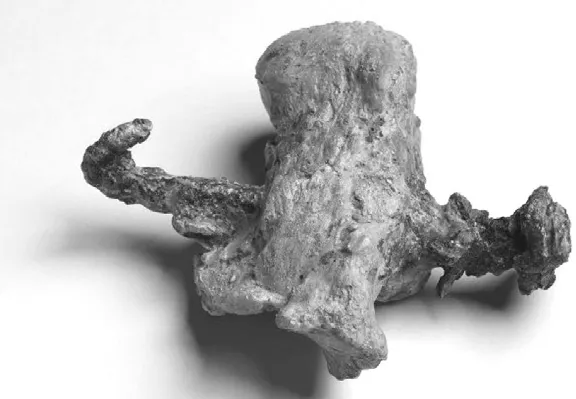
The heel bone and nail from the ossuary of Yehohanan, discovered in Jerusalem in 1968.
Although John refers to the nail-prints in Jesus’ hands (20:25) and that Jesus’ legs were not broken (vv. 32–33), there was no non-Christian evidence for the custom of nailing hands or feet to a cross. Some doubted the accuracy of the Gospels at this point.
In 1970, an Israeli archaeologist published an account of the discovery of a first-century ossuary from Jerusalem.⁶ It contained the bones of a young man who had been crucified. A blow had broken the bones of the lower leg. According to v. 32, this was done to the two men who had been crucified with Jesus, but not to Jesus Himself. The breaking of the bones of a crucifixion victim and the nailing to a cross affirms the accurate historical information in John’s Gospel.
Jesus Is Buried
³⁸ After these things Joseph of Arimathea, who was a disciple of Jesus, but secretly for fear of the Jews, asked Pilate that he might take away the body of Jesus, and Pilate gave him permission. So he came and took away his body. ³⁹ Nicodemus also, who earlier had come to Jesus by night, came bringing a mixture of myrrh and aloes, about seventy-five pounds in weight. ⁴⁰ So they took the body of Jesus and bound it in linen cloths with the spices, as is the burial custom of the Jews. ⁴¹ Now in the place where he was crucified there was a garden, and in the garden a new tomb in which no one had yet been laid. ⁴² So because of the Jewish day of Preparation, since the tomb was close at hand, they laid Jesus there.
The Burial of Jesus (vv. 38–42)
Section titled “The Burial of Jesus (vv. 38–42)”After the crucifixion, Joseph of Arimathea, a secret disciple, courageously requests Jesus’ body from Pilate (v. 38). With Nicodemus assisting, they prepare the body with a mixture of myrrh and aloes, wrap it in linen cloths, and lay it in a new tomb located in a garden near the site of the crucifixion, completing the burial before the Sabbath (vv. 39–42).
Nicodemus had earlier met Jesus in 3:1–21, seeking to understand what it means to be “born again,” and later defended Him in 7:50–51. Joseph appears at the crucifixion as a secret disciple. At the burial, he openly demonstrated devotion and faithfulness.
John emphasises the careful observance of Jewish burial customs, the devotion of Jesus’ followers, and the fulfilment of Scripture in these events. The passage highlights both the historical reality of Jesus’ death and the providential preparation that sets the stage for the resurrection, showing how human devotion and divine purpose converge in the burial.
Preaching and Teaching the Word
Section titled “Preaching and Teaching the Word”Three Words from the Cross
At the cross, Jesus speaks three powerful words. “Woman, behold your son” (vv. 26–27) establishes a new family of love and care. “I thirst” (v. 28) reveals His humanity and obedient suffering. “It is finished” (v. 30) declares the completion of redemption, unveiling Christ’s love, suffering, and victory.
The Last Encounter (19:38–42)
The burial narrative highlights the final encounters of three men, Pilate, Joseph of Arimathea, and Nicodemus, with Jesus. Each had been drawn to Him yet had never publicly followed. Their actions at the tomb reveal faith in quiet obedience. This account confronts those who hold back from full commitment, inviting quiet followers to come forward and publicly embrace discipleship, following Christ with boldness and steadfast devotion.
From Borrowed Womb to Borrowed Tomb
From His birth to His burial, Jesus lived using what was “borrowed”—a womb, a boat, a donkey, an upper room, and a tomb. His life reflects humble dependence and divine purpose. This invites believers to faithful stewardship, acknowledging that everything we possess is entrusted to us by God for His purposes and glory.