Part 1 04 — Echoes of the Old Testament
Echoes of the Old Testament
Section titled “Echoes of the Old Testament”OT Quotations in John’s Gospel
| John | OT Quotation | John | OT Quotation |
|---|---|---|---|
| 1:23 | Isa 40:3 | 12:38 | Isa 53:1 |
| 2:17 | Ps 69:9 | 12:40 | Isa 6:10 |
| 6:31 | Ps 78:24 | 13:18 | Ps 41:9 |
| 6:45 | Isa 54:13 | 15:25 | Ps 35:19 / 69:4 |
| 10:34 | Ps 82:6 | 19:24 | Ps 22:18 |
| 12:13 | Ps 118:25-26 | 19:36 | Ex 12:46 / Num 9:12 |
| 12:15 | Zech 9:9 | 19:37 | Zech 12:10 |
The Gospel of John is filled with echoes of the Old Testament through quotes, allusions, and symbolic language, framing Jesus as the fulfilment of OT prophecies and themes. Examples include the Genesis opening “In the beginning” linking to creation, Jesus’ “I Am” statements echoing God’s name in Exodus, and sacrificial imagery like the “Lamb of God” referencing Isaiah and Passover. The Passion narrative uses creation, garden, and sacrifice motifs to connect Jesus’ story to earlier biblical narratives.
The Exodus Event
Section titled “The Exodus Event”The Exodus and the Temple are two major themes that John uses to demonstrate that Jesus is the fulfilment of these central aspects of Israel’s identity and worship.
The Exodus is a foundational event in the Bible in which the Israelites were delivered from slavery in Egypt by God through the leadership of Moses. This deliverance included the ten plagues, the institution of the Passover, the crossing of the Red Sea, and the journey to Mount Sinai, where the covenant was established. Through signs and wonders, God demonstrated his power over the Egyptian gods so that both the Israelites and the Egyptians would know that He is the Lord.
The connection between the seven signs and the Exodus event lies in John’s echoing and reshaping of the original Exodus narrative. The miracles of Jesus, like the plagues of the Exodus, are described as signs and wonders that reveal God’s power and bring about redemption.
Just as the plagues displayed God’s ultimate authority over Pharaoh and the gods of Egypt, the seven signs of Jesus reveal his divine identity as the Messiah.
The Exodus Theme
Section titled “The Exodus Theme”In John’s Gospel, Jesus is presented as the fulfilment of the Exodus story and as a new Moses. His miracles, or signs, draw clear parallels to the wonders God performed through Moses, for example, just as God provided manna in the wilderness, Jesus miraculously feeds five thousand and declares himself the “bread of life,” directly linking himself to the provision of God in the Exodus. Many of Jesus’ actions occur during key Jewish festivals, such as Passover and the Feast of Tabernacles, which recall Israel’s journey from slavery to freedom. At the Feast of Tabernacles, recalling God’s guidance by a pillar of cloud and fire and the provision of water in the desert, Jesus proclaims, “If anyone is thirsty, let them come to me and drink” and declares, “I am the light of the world.”
Moreover, Jesus’ frequent use of the “I Am” statements echoes God’s self-revelation to Moses in Ex 3, further identifying him as the divine presence leading God’s people.
The Temple Theme
Section titled “The Temple Theme”In the Gospel of John, Jesus is consistently portrayed as the true temple, replacing the physical structure in Jerusalem. When challenged about cleansing the Temple, he declares, “Destroy this temple, and in three days I will raise it up” (2:19), which John clarifies refers to “the temple of his body.” Just as the temple in Israel was the dwelling place of God’s presence, the Gospel’s prologue affirms, “The Word became flesh and dwelt among us, and we have seen his glory” (1:14), using language that evokes the Tabernacle and Temple. Together, these themes present Jesus as the ultimate manifestation of God’s presence and the fulfilment of the Old Testament promises of salvation.
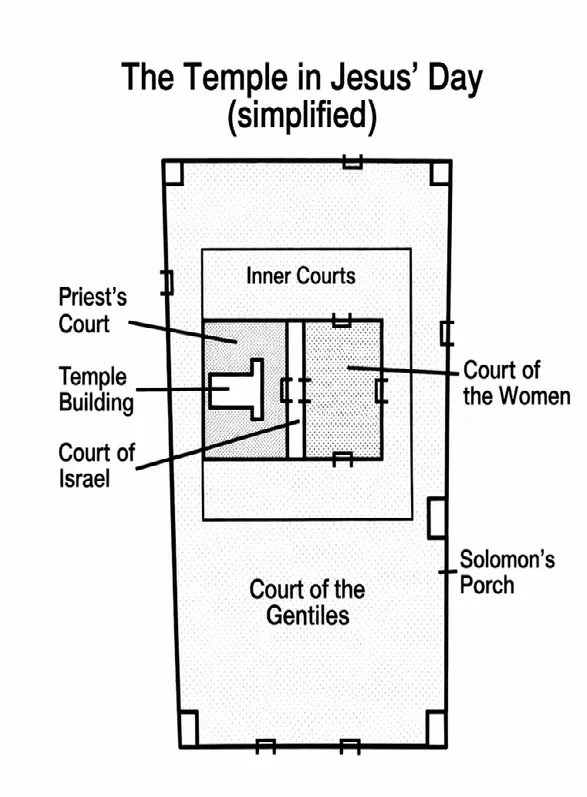
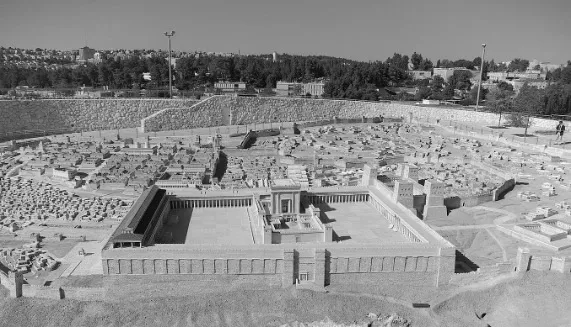
Scale model of Jerusalem, with Herod’s Temple in the foreground.
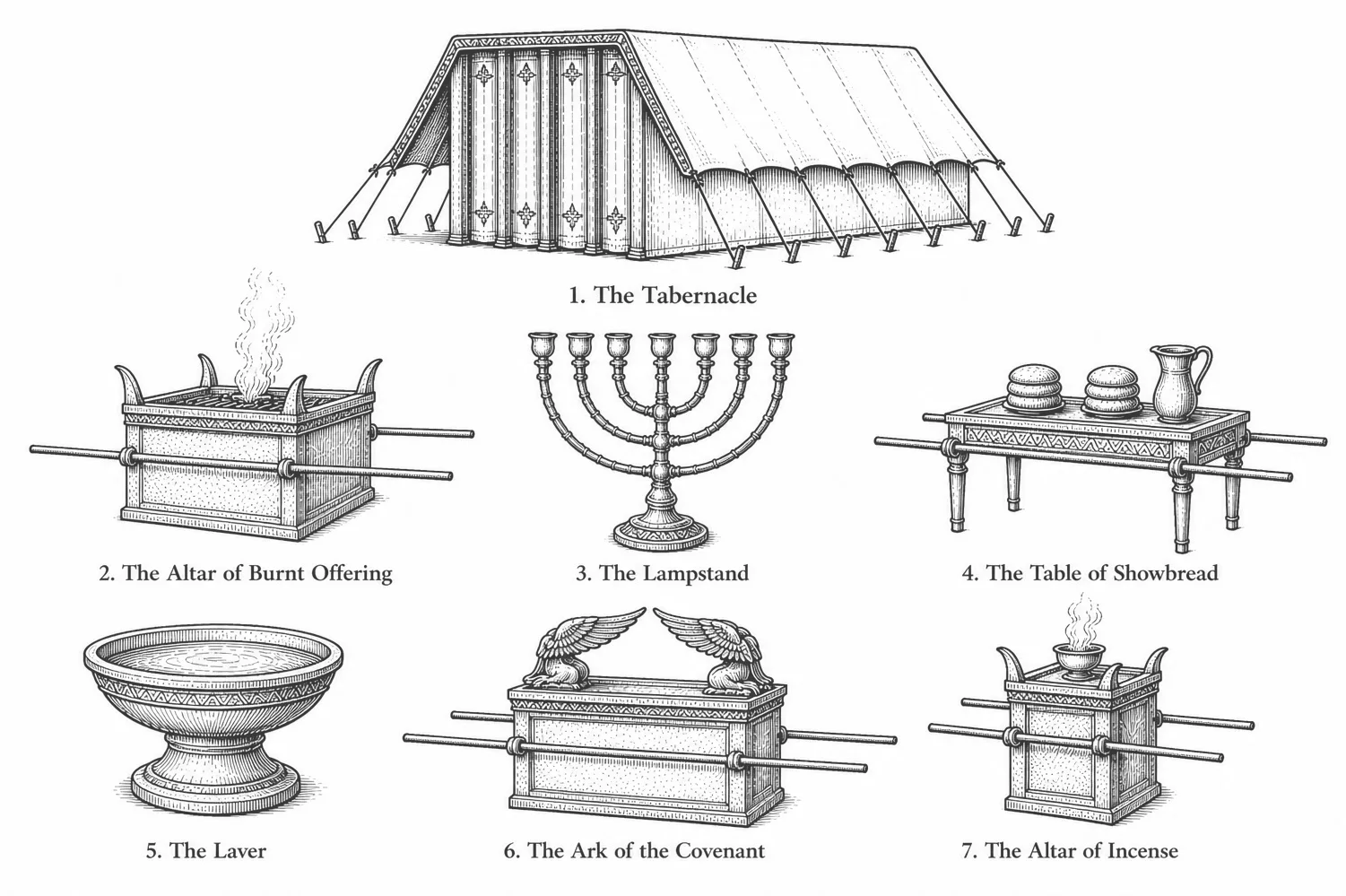
The 7 pieces of furniture of the Tabernacle.
The Furniture in the Tabernacle (Temple)
Section titled “The Furniture in the Tabernacle (Temple)”The concept that the structure of John’s Gospel mirrors the furniture of the Old Testament tabernacle serves as a particular interpretive lens for uncovering the narrative’s symbolic significance.
The Tabernacle (Temple) Parallel Interpretation views John’s Gospel as presenting Jesus as the fulfilment of the tabernacle, echoing 1:14 where the Word “tabernacled” among us. From this perspective, John’s themes follow a spiritual progression that mirrors the tabernacle’s furnishings.
Jesus is initially presented as the Lamb of God, reflecting the altar of sacrifice (1:29), and is then associated with cleansing and new birth, corresponding to the laver (John 3). He is then shown as the bread of life (John 6) and the light of the world (John 8–9), paralleling the table of showbread and the lampstand. The altar of incense is reflected in Jesus’ prayer in John 17, while the ark and mercy seat find fulfilment in his death, resurrection, and ascension. Together, these parallels present Jesus as the true dwelling place where God meets humanity.
The Jewish Festivals
Section titled “The Jewish Festivals”“Feasts of the Jews” in John’s Gospel
| Name of Feast | Reference |
|---|---|
| Passover | 2:13, 23 |
| "A feast of the Jews" | 5:1 |
| Passover | 6:4 |
| Tabernacles (Booths) | 7:2 |
| Dedication (Hanukkah) | 10:22 |
| Passover | 11:55-12:1 |
The Gospel of John is structured significantly around specific Jewish feasts and festivals, which serve as chronological markers for Jesus’ ministry and, more importantly, as thematic backdrops for his teachings and actions. John uses these festivals to demonstrate that Jesus is the fulfilment and ultimate reality of the Old Testament institutions and promises.
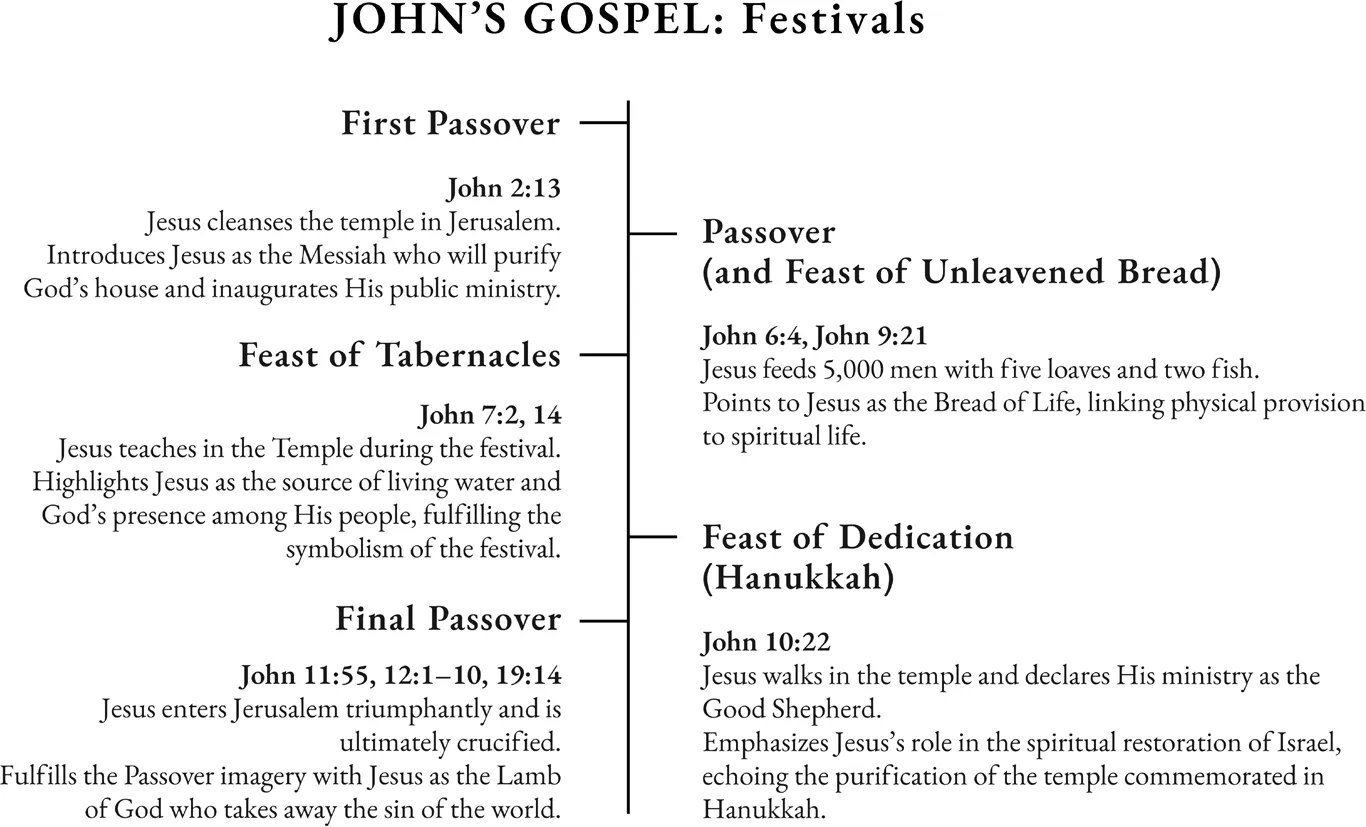
Unlike the Synoptic Gospels, which mention only one Passover at the end of Jesus’ ministry, John mentions several feasts, which helps establish a chronology spanning about three years of public ministry. Jesus is portrayed as repeatedly visiting Jerusalem for these major festivals, where the accompanying narratives and discourses take place.
For each festival, John highlights how Jesus “replaces” or brings to “completion” the specific symbolism and expectations associated with that feast.
Passover (John 2:13; 6:4; 11:55)
Passover was one of three feasts Jewish males were required to attend in Jerusalem (Tabernacles and Pentecost were the other two; see Deut 16:16). John mentions three Passovers during Jesus’ public ministry. This serves as the basis for estimating that Jesus’ public ministry lasted approximately three years. This is the central feast. Jesus is presented as the true Passover Lamb who takes away the sin of the world.
In John 2, Jesus cleanses the Temple and refers to his body as the new temple that will be raised in three days, connecting his death and resurrection to the place and time of sacrifice.
In John 6, timed near Passover, Jesus feeds the five thousand and proclaims Himself the “bread of life,” a fulfillment of the manna God provided during the Exodus.
His crucifixion is timed precisely with the slaughter of the Passover lambs in the Temple (19:14), with his bones remaining unbroken, fulfilling the specific instruction for the sacrificial lamb (Ex 12:46).
Feast of Tabernacles (Booths)
The Feast of Tabernacles (John 7), called Sukkoth by the Jewish people today, is first found in the Pentateuch (Lev 23:33–44; Num 29:12–40; Deut 16:13–17). It is the last of the seven great feasts prescribed there, and it is one of three (along with Passover and Pentecost) that all Jewish men were required to attend (Deut 16:16–17). This festival celebrated the Israelites’ forty-year journey through the wilderness. It featured prominent water and light ceremonies to symbolize God’s provision and presence (the water from the rock and the pillar of fire).
Feast of Dedication (Hanukkah)
The Feast of Dedication (10:22) celebrates the rededication of the Temple after its desecration. It was also known as the Festival of Lights. At this moment, Jesus boldly declares, “I and the Father are one” (10:30), a statement perceived as blasphemy by the Jewish leaders, as he asserts his divine nature and oneness with God, to whom the Temple itself was dedicated.
By carefully structuring his Gospel around these events, John shows that the Old Testament institutions, while valid, were preparatory steps pointing to Jesus, who is the full and final revelation of God’s redemptive plan.