Part 2 01 — The Prologue & First Disciples
The Prologue and Calling of the First Disciples
Section titled “The Prologue and Calling of the First Disciples”(1:1–51)
Section titled “(1:1–51)”The Gospel of John opens with the Prologue (1:1–18) and the calling of the first disciples, establishing Jesus’ divine identity as the Word and His mission to reveal the Father. These opening scenes are not merely historical introductions but theological signposts that frame the entire narrative. They reveal that Jesus is fully divine and fully human and invite readers to respond in faith.
By presenting the first disciples’ decision to follow Him, the Gospel calls every reader to a similar commitment: to trust Jesus wholeheartedly and live in obedient discipleship. The Prologue lays the foundation for understanding salvation and the transformative relationship with Christ.
The Gospel opens by presenting Jesus as the eternal Word who was with God and was God, the source of life and the light that shines in the darkness. The chapter moves from affirming His divine nature to revealing His mission in the world. Through the witness of John the Baptist, who testifies to the Light, and the calling of the first disciples, it shows how ordinary people are drawn into God’s extraordinary purposes through faith and obedience.
John 1
Section titled “John 1”John 1 presents Jesus as the eternal Word and the light shining in the darkness. The chapter moves from affirming His divine identity to revealing His earthly mission, highlighting the testimony of John the Baptist and the calling of the first disciples. It shows how ordinary people are drawn into God’s extraordinary purposes through faith and obedience.
Places and People Profile
Section titled “Places and People Profile”Place Profile
Section titled “Place Profile”- Bethany: Name means “house of unripe figs.”
- Bethsaida: Name means “house of fishing.” Located by the Sea of Galilee close to Capernaum.
People Profile
Section titled “People Profile”- Andrew: The name means “manly.” Son of Jonas, brother of Simon Peter. Friend of Philip, who was also from Bethsaida.
- John the Baptist: Born six months before Jesus to Zachariah and Elizabeth. Jesus’ cousin beheaded by Herod Antipas.
- Simon Peter: Simon was his original name. Peter (rock) was a name given by Jesus. A fisherman from Bethsaida. The only disciple we know was married (Mark 1:30; 1 Cor. 9:5). With James and John, part of Jesus’ “inner circle” (Mark 5:37; 9:2; 14:33). Leader of the Jerusalem church in the early chapters of Acts.
- Philip: The name means “lover of horses.” Philip the apostle of the Gospels should not be confused with Philip the evangelist of Acts 6, 8, and 21. Probably the first disciple of John the Baptist.
- Nathanael: The name means “God has given.” Praised by Jesus for his integrity. Also known as Bartholomew.
The Prologue (1:1–18)
Section titled “The Prologue (1:1–18)”The Word became flesh
1 In the beginning was the Word, and the Word was with God, and the Word was God. 2 He was in the beginning with God. 3 All things were made through him, and without him was not any thing made that was made. 4 In him was life, and the life was the light of men.
5 The light shines in the darkness, and the darkness has not overcome it.
6 There was a man sent from God, whose name was John. 7 He came as a witness, to bear witness about the light, that all might believe through him. 8 He was not the light, but came to bear witness about the light. 9 The true light, which gives light to everyone, was coming into the world. 10 He was in the world, and the world was made through him, yet the world did not know him. 11 He came to his own, and his own people did not receive him. 12 But to all who did receive him, who believed in his name, he gave the right to become children of God, 13 who were born, not of blood nor of the will of the flesh nor of the will of man, but of God. 14 And the Word became flesh and dwelt among us, and we have seen his glory, glory as of the only Son from the Father, full of grace and truth. 15 (John bore witness about him, and cried out, “This was he of whom I said, ‘He who comes after me ranks before me, because he was before me.’”) 16 For from his fullness we have all received, grace upon grace. 17 For the law was given through Moses; grace and truth came through Jesus Christ. 18 No one has ever seen God; God the only Son, who is at the Father’s side, he has made him known.
The Prologue of John’s Gospel functions like an overture to an opera, introducing the major themes and displaying the majesty of Christ. It prepares readers for the unfolding narrative of revelation, rejection, redemption, and glory that shapes the Gospel. Jesus is portrayed as the eternal Word who was with God and became flesh to reveal God.
The passage contrasts light and darkness, belief and unbelief, and introduces John the Baptist as a witness to the Light. Its central message is that true life and salvation are found in Jesus, the Light of the world.
Structurally, the Prologue may be viewed as a chiasm, with its focal point in v. 12b, where those who believe are granted the right to become children of God.
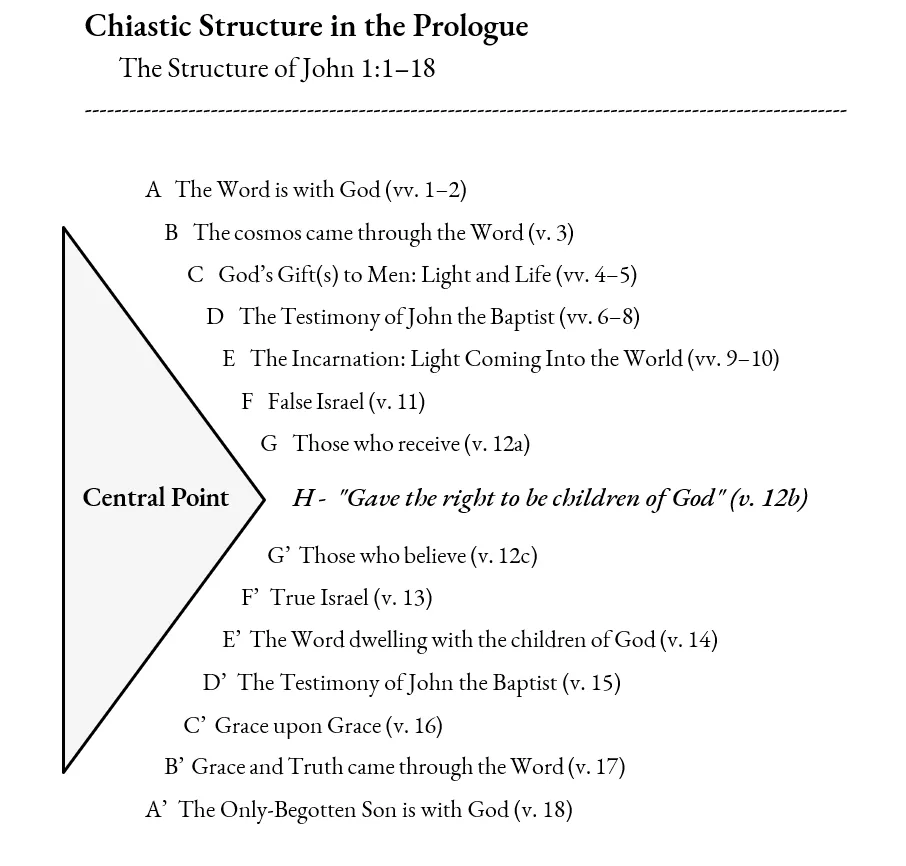
The Chiastic Structure of John 1:1–18
“Step-stair” Parallelism
Section titled ““Step-stair” Parallelism”Stanton observes that the Prologue displays a form of “step-stair” parallelism, which can be seen clearly in a translation of vv. 1–5.¹
“Step-stair” Parallelism of John 1:1–5
-
In the beginning was the Word
And the Word was with God
And what God was, the Word was.
-
The Word was in the beginning with God.
-
All things were made through him,
And without him was not anything made.
-
What was made in him was life
And the life was the light of men.
-
And the light shines in the darkness
And the darkness did not master it.
The Word and Creation (vv. 1–5)
Section titled “The Word and Creation (vv. 1–5)”“In the beginning,” (v. 1) echoes Gen 1:1. Just as God created by His word in Genesis, John identifies that Word as a person who was with God and was God, through whom all things were made. “He was in the beginning with God” (v. 2) attests to Christ’s pre-existence. In other words, before Jesus Christ came to earth, he existed in eternity past as the Son of God, the second member of the Trinity.
God caused light to shine in the darkness and granted life to humans. John says as much of Jesus in vv. 3–5. He states it positively in verse 3a, “All things were made through him,” and then negatively in 3b. “and without him was not any thing made that was made.” The term “made” (egeneto) in v. 3 is used in the Septuagint (Greek version of the Old Testament) of Gen 1 for God’s act of creation. And the terms “life” and “light” take the reader back to the creation account in Gen 1. John seems to be saying that Jesus was God’s agent in creation: he brought the world into being, caused God’s light to shine, and gave life to creation.
The contrast between light and darkness is a central theme in John’s Gospel. It is first introduced in vv. 4–9 and later explored in Jesus’ conversation with Nicodemus (3:19–21). This theme reaches its fullest expression when Jesus declares, “I am the light of the world. Whoever follows me will not walk in darkness, but will have the light of life” (8:12).
John the Baptist (vv. 6–9)
Section titled “John the Baptist (vv. 6–9)”John the Baptist (who was not called the Baptist in this gospel) appears in vv. 6–9, sent by God to bear witness to Christ, the true Light. His mission was to direct people toward Jesus so that they might believe in Him (v. 7). The Gospel repeatedly uses the verb “believe” (pisteuō), emphasising that faith is not mere intellectual assent to a creed but a personal, living relationship of trust and obedience to Christ.
Rejected by the World (vv. 10–13)
Section titled “Rejected by the World (vv. 10–13)”Verses 10–11 reveal a striking irony that Jesus, the Jewish Messiah, was not received by His own people. The word “world” (kosmos) appears three times in v. 10 and carries three distinct meanings in John’s Gospel: the created universe, humanity, and the evil system that stands in opposition to God.
Those who received Jesus and believed in Him were granted the right to become children of God (vv. 12–13), entering a new life of divine relationship. The themes of light and life also reappear. The light that dispels darkness in Genesis now shines in the world through the Word. The focus then moves from the first creation to re-creation. Those who receive the Word are given new birth as children of God, not by human means, but by God’s initiative.
Echoes of Exodus in the Prologue (vv. 14–18)
Section titled “Echoes of Exodus in the Prologue (vv. 14–18)”The focus of vv. 14–18 is the contrast between Christ and Moses. The word “dwelt” (v. 14) comes from the Greek verb eskēnōsen, meaning “to tabernacle” or “to pitch a tent.” John proclaims that God Himself came to live among humanity in the person of Jesus. He is the true tabernacle and the new temple. In Him, God’s glory took on human flesh and now abides among His people, and through Him, that glory is revealed in His followers.
Jesus is greater than John the Baptist (v. 15) because He existed before John. Verse 16 may be translated literally as “grace in place of grace,” most likely referring to the grace of Christ’s new covenant replacing the grace associated with the covenant given through Moses.
Verse 17 contrasts Moses’ law, which was based on works, with Christ’s covenant, which is based on grace, and v. 18 alludes to the fact that Moses was not permitted to see God’s face while Jesus was at God’s side in eternity past, viewing his glory face-to-face and now revealing that glory to his followers.
| Theme | Occurrence |
|---|---|
| Light | 23 |
| Truth | 38 |
| Life | 36 |
| Son | 43 |
| Glory | 42 |
| Witness | 54 |
| World | 79 |
| God | 82 |
| Believe | 98 |
Verses 14–18 therefore echo the revelation of God’s glory in Ex 33–34 by presenting Jesus as the fullest disclosure of God. Whereas Moses experienced a partial glimpse of God and received the Law, Jesus dwells among humanity as the incarnate Word, revealing God’s grace and truth and inaugurating the new covenant of redemption and relationship.
The prologue sums up the main themes of John’s theology. Several themes in the prologue continue throughout the entire Gospel.
John the Baptist’s Relation to Jesus (1:19–34)
Section titled “John the Baptist’s Relation to Jesus (1:19–34)”The testimony of John the Baptist
19 And this is the testimony of John, when the Jews sent priests and Levites from Jerusalem to ask him, “Who are you?” 20 He confessed, and did not deny, but confessed, “I am not the Christ.” 21 And they asked him, “What then? Are you Elijah?” He said, “I am not.” “Are you the Prophet?” And he answered, “No.” 22 So they said to him, “Who are you? We need to give an answer to those who sent us. What do you say about yourself?” 23 He said, “I am the voice of one crying out in the wilderness, ‘Make straight the way of the Lord,’ as the prophet Isaiah said.”
24 (Now they had been sent from the Pharisees.) 25 They asked him, “Then why are you baptizing, if you are neither the Christ, nor Elijah, nor the Prophet?” 26 John answered them, “I baptize with water, but among you stands one you do not know, 27 even he who comes after me, the strap of whose sandal I am not worthy to untie.” 28 These things took place in Bethany across the Jordan, where John was baptizing.
John the Baptist’s Relation to Jesus (vv. 19–28)
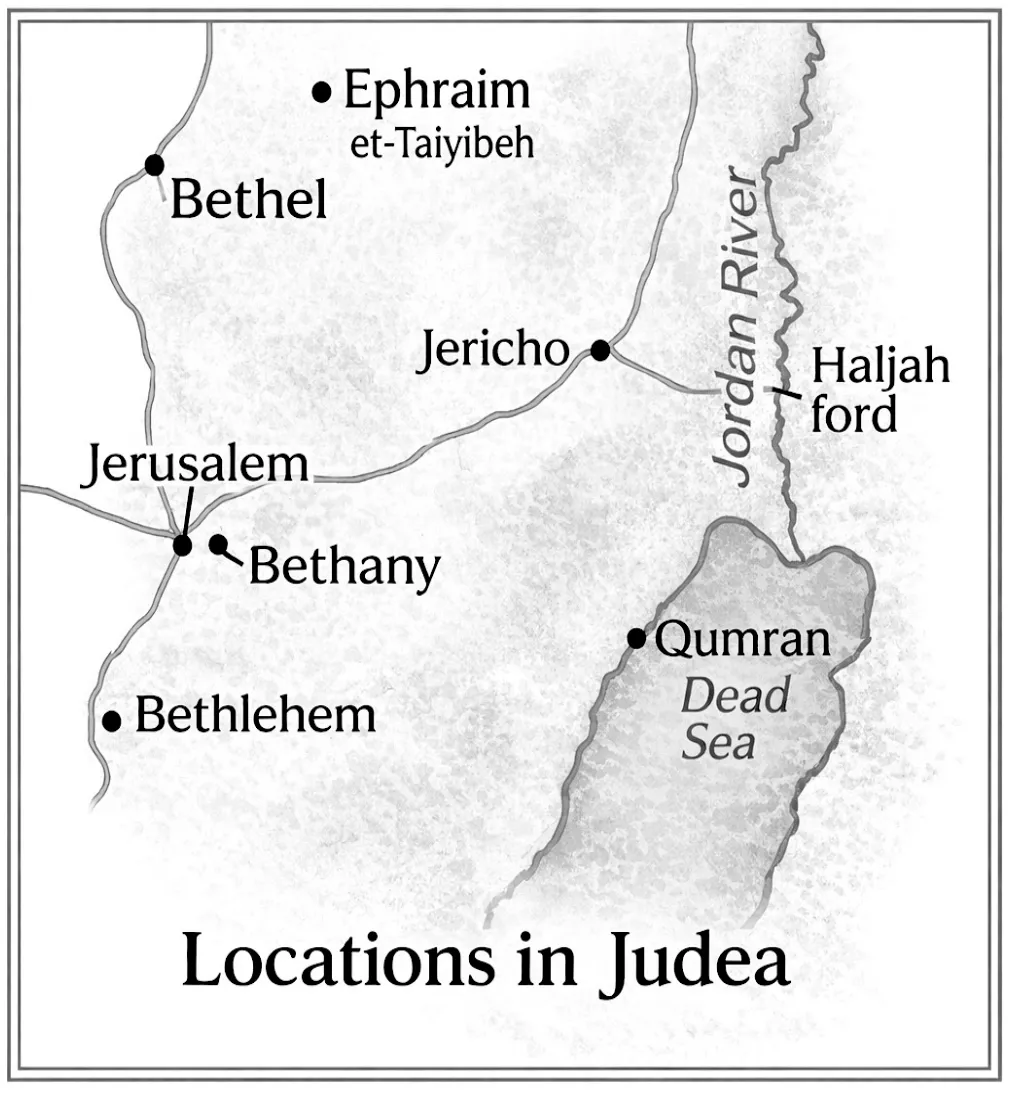
Section titled “John the Baptist’s Relation to Jesus (vv. 19–28)”This episode unfolds at Bethany beyond the Jordan (v. 28) and marks the opening scene in John’s narrative sequence.
While John the Baptist is baptising, priests and Levites are sent from Jerusalem to question him about who he is and the authority by which he acts (vv. 19, 24–25). The delegation asks a series of questions, and John the Baptist clearly rejects each claim. He denies being the Messiah, saying, “I am not the Christ” (v. 20), and likewise refuses the identities of Elijah, “I am not,” and the Prophet, “No” (v. 21).
When pressed to identify himself, “Who are you? We need to give an answer to those who sent us” (v. 22), he cites Isaiah 40:3, describing himself as the voice of one crying, “I am the voice of one crying out in the wilderness, ‘Make straight the way of the Lord’” (v. 23; cf. Isa 40:3).
John the Baptist understands his role not in terms of status, but as a forerunner whose task is to prepare the way for another. The inquiry then turns to his authority to baptise. He responds briefly, stating that he is sent to baptise with water (v. 33).
The setting at Bethany across the Jordan recalls important Old Testament associations, including Elijah’s ascent, Elisha’s mighty works, and Naaman’s cleansing. John the Baptist’s ministry stands firmly within the prophetic tradition, pointing ahead to Jesus, whose work will exceed that of Elijah.
The Parallel between Elijah and John the Baptist
Section titled “The Parallel between Elijah and John the Baptist”The priests and Levites from Jerusalem thought that John the Baptist might be Elijah (v. 21), since the two shared certain similarities.²
| Elijah | John the Baptist |
|---|---|
| Taken to heaven in the wilderness of Judea | Arrived in the wilderness of Judea |
| Covered in hair with a leather waistband | Wore clothes of camel hair and a leather waistband |
| Subsisted on simple food and drink | Subsisted on simple food and drink |
| Preached against Ahab, Jezebel, and priests of Baal | Preached against Herod, Pharisees, and Sadducees |
| Called the people to return to Yahweh | Called the people to repent |
John the Baptist’s Public Witness Concerning Jesus (vv. 29–34)
Section titled “John the Baptist’s Public Witness Concerning Jesus (vv. 29–34)”Behold, the Lamb of God
29 The next day he saw Jesus coming toward him, and said, “Behold, the Lamb of God, who takes away the sin of the world! 30 This is he of whom I said, ‘After me comes a man who ranks before me, because he was before me.’ 31 I myself did not know him, but for this purpose I came baptizing with water, that he might be revealed to Israel.” 32 And John bore witness: “I saw the Spirit descend from heaven like a dove, and it remained on him. 33 I myself did not know him, but he who sent me to baptize with water said to me, ‘He on whom you see the Spirit descend and remain, this is he who baptizes with the Holy Spirit.’ 34 And I have seen and have borne witness that this is the Son of God.”
The next day, John the Baptist addresses the wider public, openly identifying Jesus and clarifying his own ministry. In vv. 29–30, he announces Jesus as the Lamb of God who removes the sin of the world, identifying Him as God’s chosen redeemer for humanity. In v. 31, he clarifies that his baptism with water is meant to direct people to Jesus, who will baptise them with the Holy Spirit. Water signifies preparation and repentance, whereas Spirit baptism marks the promised work of inner cleansing and renewal.
He concludes in v. 34 by testifying that Jesus is “the Son of God,” fulfilling Jewish messianic hopes. The repeated use of titles such as “Messiah” and “Son of God” frames the passage, underscoring that recognising Jesus’ true identity lies at the heart of the Gospel’s message.
The First Disciples (1:35–51)
Section titled “The First Disciples (1:35–51)”Jesus Calls the First Disciples
35 The next day again John was standing with two of his disciples, 36 and he looked at Jesus as he walked by and said, “Behold, the Lamb of God!” 37 The two disciples heard him say this, and they followed Jesus. 38 Jesus turned and saw them following and said to them, “What are you seeking?” And they said to him, “Rabbi” (which means Teacher), “where are you staying?” 39 He said to them, “Come and you will see.” So they came and saw where he was staying, and they stayed with him that day, for it was about the tenth hour. 40 One of the two who heard John speak and followed Jesus was Andrew, Simon Peter’s brother. 41 He first found his own brother Simon and said to him, “We have found the Messiah” (which means Christ). 42 He brought him to Jesus. Jesus looked at him and said, “You are Simon the son of John. You shall be called Cephas” (which means Peter).
Jesus Calls His First Disciples (vv. 35–42)
Section titled “Jesus Calls His First Disciples (vv. 35–42)”Starting in v. 29, John links sections of his narrative with the expression “the next day;” in v. 35, it is “the next day” again. We can reconstruct an entire week of ministry as follows³:
- Day 1: John’s testimony regarding Jesus (vv. 19–28)
- Day 2: John’s encounter with Jesus (vv. 29–34; “the next day”)
- Day 3: John’s referral of two disciples to Jesus (vv. 35–39; “the next day”)
- Day 4: Andrew’s introduction of his brother Peter to Jesus (vv. 40–42)
- Day 5: Philip and Nathanael follow Jesus (vv. 43–51; “the next day”)
- Day 7: Wedding at Cana (2:1–11; “on the third day”)
Thus, we see John opening his gospel with an account of Jesus’ first week of ministry (possibly mirroring God’s creation of the world in seven days), culminating in his “first sign” at Cana.
What a remarkable week of ministry it proves to be! John the Baptist’s testimony sets off a chain reaction, drawing a growing number of followers to Jesus. His initial witness leads Andrew and another disciple (possibly John, the son of Zebedee) to follow Jesus (vv. 35, 40), and Andrew then brings his brother Peter to Him (vv. 41–42).
Jesus Calls Philip and Nathanael (vv. 43–51)
Section titled “Jesus Calls Philip and Nathanael (vv. 43–51)”Jesus Calls Philip and Nathanael
43 The next day Jesus decided to go to Galilee. He found Philip and said to him, “Follow me.” 44 Now Philip was from Bethsaida, the city of Andrew and Peter. 45 Philip found Nathanael and said to him, “We have found him of whom Moses in the Law and also the prophets wrote, Jesus of Nazareth, the son of Joseph.” 46 Nathanael said to him, “Can anything good come out of Nazareth?” Philip said to him, “Come and see.” 47 Jesus saw Nathanael coming toward him and said of him, “Behold, an Israelite indeed, in whom there is no deceit!” 48 Nathanael said to him, “How do you know me?” Jesus answered him, “Before Philip called you, when you were under the fig tree, I saw you.” 49 Nathanael answered him, “Rabbi, you are the Son of God! You are the King of Israel!” 50 Jesus answered him, “Because I said to you, ‘I saw you under the fig tree,’ do you believe? You will see greater things than these.” 51 And he said to him, “Truly, truly, I say to you, you will see heaven opened, and the angels of God ascending and descending on the Son of Man.”
Jesus calls Philip, who is from the same town (Bethsaida) as Andrew and Peter, to follow Him (vv. 43–44), and Philip brings Nathanael (vv. 45–51).
When Philip invites Nathanael, he expresses scepticism, asking, “Can anything good come out of Nazareth?” Yet he responds to the invitation to “Come and see” (v. 46). Jesus demonstrates supernatural knowledge of Nathanael, saying, “Behold, an Israelite indeed, in whom there is no deceit!” (v. 47), which leads Nathanael to confess, “Rabbi, you are the Son of God! You are the King of Israel!” (v. 49). Jesus then promises even greater revelations: “You will see heaven opened, and the angels of God ascending and descending on the Son of Man” (v. 51).
This sequence of events shows that discipleship is relational. Testimony leads to encounter, encounter to invitation, and invitation to further sharing. Following Christ begins personally but naturally spreads through relationships.
The Dynamics of Who Calls Whom to Discipleship
Section titled “The Dynamics of Who Calls Whom to Discipleship”| Disciple | Verses | Action |
|---|---|---|
| The 1st & 2nd Disciples | Vv. 35–39 | John the Baptist sends two of his disciples to follow Jesus. One is named Andrew, but the other remains anonymous. |
| The 3rd Disciple | Vv. 40–42 | Andrew brings his brother Simon (Peter) to Jesus. |
| The 4th Disciple | Vv. 43–44 | Jesus finds and invites Philip personally. |
| The 5th Disciple | Vv. 45–51 | Philip talks to Nathanael about Jesus. |
Baptism and Jewish Ritual Washings
Section titled “Baptism and Jewish Ritual Washings”When John the Baptist says, “I baptise with water” in v. 26, he is carrying out the water cleansing that the Law required for removing ritual impurity. By Jesus’ time, the purification rites required a full immersion in a mikveh. Both men and women are required to bathe themselves upon becoming Jews. According to Everett Ferguson, “it is widely assumed that proselyte baptism was earlier than the Christian era.“⁴
Josephus describes the baptism of John the Baptist in ways that resemble the ritual washings practiced by the Qumran community,⁵ which bathed daily as a form of purification. However, his baptism differs from the Qumran washings in two ways: it was a “baptism of repentance for the forgiveness of sins” (Luke 3:3), and it was a one-time, definitive act. By contrast, the Qumran immersions were performed daily in order to maintain ritual purification.
Testimony to Jesus
Section titled “Testimony to Jesus”John the Baptist bears testimony to Jesus as “the lamb of God” (vv. 29, 36) and as “the Son of God” (v. 34). Andrew tells Simon Peter that Jesus is the Messiah-Christ (v. 41). Nathanael confesses that Jesus is “the Son of God, the king of Israel” (v. 49). At the end of the Prologue Jesus refers to himself as the Son of Man (v. 51).
The stage is now set for John to relate the good news of Jesus Christ, beginning with His first sign, the miracle of turning water into wine, at Cana of Galilee.
Textual Variant⁶
Section titled “Textual Variant⁶”“Only Begotten Son” or “Only Begotten God” (v. 18)
Section titled ““Only Begotten Son” or “Only Begotten God” (v. 18)”The first textual variant is in v. 18. The debate concerns whether the original wording was “only begotten Son” or “only begotten God.” The earliest and most reliable manuscripts support “only begotten God,” leading many scholars to accept it as the original reading. This variant frames the Prologue’s strong emphasis on Jesus’ full deity, declaring that the Word is God made flesh and reaffirming His divine identity both at the beginning (v. 1) and at the climax (v. 18). It thus reinforces the Gospel’s theological message of Christ’s unique divine revelation.
“The Chosen One of God” or “The Son of God” (v. 34)
Section titled ““The Chosen One of God” or “The Son of God” (v. 34)”The second textual variant appears in v. 34. The earliest and most reliable manuscripts read “Son of God,” whereas “Chosen One of God” is found in later manuscript traditions. Consequently, most modern critical editions of the Greek New Testament recognize “Son of God” as the original wording.
Preaching and Teaching the Word
Section titled “Preaching and Teaching the Word”At Christmas Time (1:1–18)
John 1:1–18 lies at the heart of Christmas preaching. Although the manger scene is not recorded, the Prologue reveals the eternal significance of Christ’s birth. The Word, who was with God and was God, became flesh and lived among us. Christmas preaching from this passage highlights the glory, grace, and saving purpose of the incarnation.
The Light Shines in the Darkness (1:4–5, 9–13)
Christ is the true Light, shining in darkness and never overcome. This message offers hope amid despair. He came to expose sin, grant life, and bring new birth to all who receive Him by faith.
A New Beginning (1:12–13; 1:51)
Those who receive Christ are granted the right to become children of God, born of Him. The vision of heaven points to the new creation, calling believers to renewed faith, deeper devotion, and stronger commitment to Christ.
Come and See (1:35–39, 43–46)
Jesus’ personal invitation calls individuals to encounter Him. The first disciples responded immediately and brought others to Christ. This theme challenges seekers to explore who Jesus is and encourages believers to live in renewed obedience, faithful witness, and wholehearted commitment.