Part 1 02 — Structure
Structure
Section titled “Structure”The Gospel of John is divided into four parts:
- Prologue (1:1-18)
- The Book of Signs (1:19–12:50)
- The Book of Glory (13:1–20:31)
- Epilogue (21:1-25)
There is wide agreement in the scholarly literature that John’s Gospel breaks down into a Prologue; a first major unit called “The Book of Signs,” which focuses on Jesus’ public ministry; a second major unit termed “The Book of Glory,” which anticipates Jesus’ exaltation with the Father after his crucifixion, burial, and resurrection; and an Epilogue.
Overview of the Gospel of John
Section titled “Overview of the Gospel of John”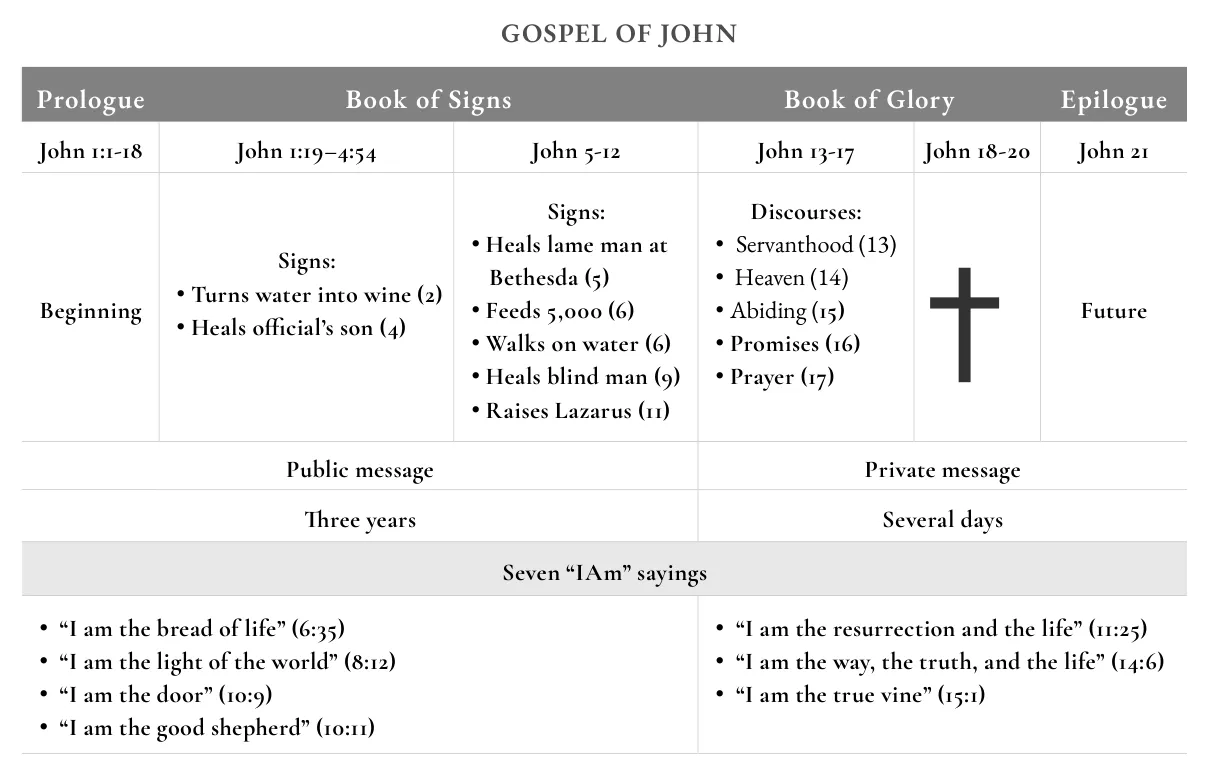
The Book of Signs and the Book of Glory
Section titled “The Book of Signs and the Book of Glory”Between the Prologue and the Epilogue lie two major sections: the “Book of Signs” and the “Book of Glory.”
The Book of Signs
Section titled “The Book of Signs”The “Book of Signs” refers to John 1:19–12:50. It records a series of miraculous signs through which Jesus reveals His identity and glory. These signs are not ends in themselves but pointers, calling readers to believe that Jesus is the Christ, the Son of God. Through changing water into wine, healing the sick, feeding the multitude, and raising the dead, John shows that belief in Jesus brings life. The “Book of Signs” leads steadily toward the cross, where the fullest sign of God’s love is revealed.
The Seven Signs
Section titled “The Seven Signs”John presents seven miraculous signs (sēmeia). These are works of power that point beyond themselves to a deeper spiritual truth. Each sign is carefully selected and strategically placed to illuminate Jesus’ glory and provoke belief.
The signs function as a theological lens through which the reader is invited to see the identity of Christ and respond in faith. John intentionally calls them “signs” rather than “miracles” to emphasise that these acts signify a reality greater than themselves, for they point to the ultimate glory of God revealed in Jesus.
Echoes of the Exodus in the Seven Signs
Section titled “Echoes of the Exodus in the Seven Signs”The seven signs are often understood against the backdrop of the Exodus, with several highlighting its central themes.
The feeding of the multitude recalls the manna in the wilderness, pointing to Jesus as the true bread from heaven. The walking on the sea evokes God’s mastery over the waters at the Red Sea. The healing of the official’s son and the lame man reflect God’s life-giving and restorative power, reminiscent of Israel’s preservation in the wilderness.
The healing of the man born blind echoes Israel’s passage from darkness to light, while the raising of Lazarus points to a final Exodus from death itself. Together, the seven signs present Jesus as the fulfiller of the Exodus hope, bringing a new redemption in which God reveals His glory.
The Seven “I Am” Sayings
Section titled “The Seven “I Am” Sayings”Interwoven with the seven signs are Jesus’ seven “I Am” sayings, which echo the divine name revealed to Moses in Ex 3:14. Each declaration reveals a vital aspect of His identity and mission, highlighting His authority, divinity, and the salvation He brings to His people.
Echoes of the Exodus in the Seven “I Am” Sayings
Section titled “Echoes of the Exodus in the Seven “I Am” Sayings”Jesus’ seven “I Am” sayings draw on imagery connected to God’s presence and provision during Israel’s journey from Egypt to the Promised Land. In Ex 3:14, when Moses asks God for his name so that he can tell the Israelites who sent him, God responds, “I AM WHO I AM” (Hebrew: Ehyeh Asher Ehyeh). God then instructs Moses to say to the people, “I AM has sent me to you.”
In the Gospel of John, Jesus uses the phrase “I Am” (ego eimi) in a way that clearly points back to this foundational Exodus revelation, making an explicit claim to deity. The Jewish leaders understood the seriousness of this claim, which explains their accusations of blasphemy and their attempts to stone Him (10:31).
Relationship Between the Signs and the “I Am” Sayings
Section titled “Relationship Between the Signs and the “I Am” Sayings”Together, the signs and the “I Am” sayings create a rich theological tapestry. The signs reveal Jesus’ glory in action, while the “I Am” sayings reveal His glory in words. By studying them side by side, we are drawn into a deeper understanding of who Jesus is, what He came to accomplish, and how we are invited to respond with faith and devotion.
As we explore the signs and sayings in this book, we will see that John’s Gospel is not just a historical account. It is an invitation to encounter Christ personally, to believe in Him, and to live in the light of His transforming presence.
The seven signs and the seven “I Am” sayings function together to reveal Jesus’ divine identity as the Messiah. The signs are visible actions that point to a deeper reality, while the “I Am” statements interpret and explain the meaning of those actions.
The healing of the man born blind (9:1–11) corresponds with Jesus’ declaration, “I am the light of the world” (8:12). The restoration of physical sight illustrates his claim to bring spiritual light where there was only darkness. The raising of Lazarus (11:1–44) is paired with Jesus’ statement, “I am the resurrection and the life” (11:25). This climactic sign demonstrates his authority over death and confirms his claim to be the source of life and the giver of eternal life.
Seven Signs and “I Am” Sayings
| # | Sign | "I Am" Saying | Significance |
|---|---|---|---|
| 1 | Turning water into wine (2:1–11) | I am the True Vine (15:1) | Symbolises the life and joy that flows from abiding in Christ |
| 2 | Healing the official's son (4:46–54) | I am the Way, the Truth, and the Life (14:6) | The truth of Jesus' word, "Your son will live," is confirmed |
| 3 | Healing the lame man at Bethesda (5:1–15) | I am the Door (10:9) | The healing at the Sheep Gate points to Jesus as the entry for salvation |
| 4 | Feeding the five thousand (6:1–14) | I am the Bread of Life (6:35) | Just as He fed the crowd physically, He provides spiritual nourishment |
| 5 | Walking on water (6:16–21) | I am the Good Shepherd (10:11) | He keeps His disciples safe during the tempest, showing His devoted care |
| 6 | Healing the man born blind (9:1–41) | I am the Light of the World (8:12) | Giving physical sight to the blind man shows His power to provide spiritual sight in a dark world |
| 7 | Raising Lazarus from the dead (11:1–44) | I am the Resurrection and the Life (11:25) | The ultimate sign over death |
The Book of Glory
Section titled “The Book of Glory”The “Book of Glory” refers to John 13–20 (John 21 is the Epilogue), where Jesus’ coming glory is revealed through suffering, death, and resurrection. Glory is not displayed through power or spectacle, but through humble service, obedient love, and self-giving sacrifice. The foot washing, farewell discourses, the cross, and the resurrection all show that Jesus is glorified as He completes the Father’s work.
In John’s Gospel, the cross is not defeat but exaltation, the moment when God’s love and purpose are most fully revealed. In the Book of Glory, Jesus fulfils the Exodus, leading His people from death to life, chaos to peace, and fear to hope. As the true Passover Lamb, He delivers His followers and, through the Spirit, dwells with them, forming a new covenant community of love and unity.