Part 3 02 — The Farewell Discourse and Jesus' Final Prayer
The Farewell Discourse, and Jesus’ Final Prayer
Section titled “The Farewell Discourse, and Jesus’ Final Prayer”(14:1–17:26)
In John 14–17, Jesus comforts His disciples and prepares them for His departure. He promises the Holy Spirit as their guide and helper and calls them to abide in His love. In His prayer, He intercedes for Himself, His disciples, and future believers, revealing that true glory is shown through love, unity, and the ongoing work of God among His people.
John 14
Section titled “John 14”Jesus commences His Farewell Discourse in John 14 by turning His attention inward. He emphasises His imminent return to the Father and His promise to send the Holy Spirit, who will guide, strengthen, and comfort the disciples after His departure. The Holy Spirit will provide an ongoing presence and help to the disciples, so that they may continue in their faith.
People Profile
Section titled “People Profile”- Judas: One of six individuals in the New Testament with this name. He was an apostle of Jesus, often referred to as “Judas son of James” (Luke 6:16). He is also identified as “not Iscariot.”
The Benefits of Jesus’ Departure for His Disciples (14:1–31)
Section titled “The Benefits of Jesus’ Departure for His Disciples (14:1–31)”I Am the Way, and the Truth, and the Life
¹ “Let not your hearts be troubled. Believe in God; believe also in me.
² In my Father’s house are many rooms. If it were not so, would I have told you that I go to prepare a place for you? ³ And if I go and prepare a place for you, I will come again and will take you to myself, that where I am you may be also. ⁴ And you know the way to where I am going.“
⁵ Thomas said to him, “Lord, we do not know where you are going. How can we know the way?” ⁶ Jesus said to him, “I am the way, and the truth, and the life. No one comes to the Father except through me. ⁷ If you had known me, you would have known my Father also. From now on you do know him and have seen him.”
⁸ Philip said to him, “Lord, show us the Father, and it is enough for us.” ⁹ Jesus said to him, “Have I been with you so long, and you still do not know me, Philip? Whoever has seen me has seen the Father. How can you say, ‘Show us the Father’? ¹⁰ Do you not believe that I am in the Father and the Father is in me? The words that I say to you I do not speak on my own authority, but the Father who dwells in me does his works. ¹¹ Believe me that I am in the Father and the Father is in me, or else believe on account of the works themselves.
¹² “Truly, truly, I say to you, whoever believes in me will also do the works that I do; and greater works than these will he do, because I am going to the Father. ¹³ Whatever you ask in my name, this I will do, that the Father may be glorified in the Son. ¹⁴ If you ask me anything in my name, I will do it.
Jesus’ opening words in His Farewell Discourse are: “In my Father’s house are many rooms… I go to prepare a place for you” (v. 2). He paints a picture of a bridegroom preparing a home for his bride. He is like the bridegroom, preparing a place in His Father’s house and promising to return to bring His followers, His bride, into eternal fellowship and joy with Him. This imagery highlights intimacy, care, and the certainty of union with Christ.
We are assured that He will personally bring each believer to be with Him, even if believers die at the same time in different places. God’s power and presence are not limited by time or space, and He is fully able to gather every follower into His eternal kingdom.
The Sixth “I Am” Saying: “I Am the Way, the Truth, and the Life” (v. 6)
Section titled “The Sixth “I Am” Saying: “I Am the Way, the Truth, and the Life” (v. 6)”In response to Thomas’ question, “Lord, we do not know where you are going. How can we know the way?” (v. 5), Jesus replies with His sixth “I am” saying, identifying Himself as the only path to the Father, the full revelation of God’s truth, and the source of true life (v. 6).
Jesus further promises that those who know Him know the Father (vv. 7–9), linking obedience and relationship with Him directly to the knowledge of God. He assures them that prayers offered in His name will be answered (vv. 13–14), not as a formula but in alignment with God’s will and purpose, reinforcing the unity of His mission with the Father.
Jesus Promises the Holy Spirit
¹⁵ “If you love me, you will keep my commandments. ¹⁶ And I will ask the Father, and he will give you another Helper, to be with you forever, ¹⁷ even the Spirit of truth, whom the world cannot receive, because it neither sees him nor knows him. You know him, for he dwells with you and will be in you.
¹⁸ “I will not leave you as orphans; I will come to you. ¹⁹ Yet a little while and the world will see me no more, but you will see me. Because I live, you also will live. ²⁰ In that day you will know that I am in my Father, and you in me, and I in you. ²¹ Whoever has my commandments and keeps them, he it is who loves me. And he who loves me will be loved by my Father, and I will love him and manifest myself to him.” ²² Judas (not Iscariot) said to him, “Lord, how is it that you will manifest yourself to us, and not to the world?” ²³ Jesus answered him, “If anyone loves me, he will keep my word, and my Father will love him, and we will come to him and make our home with him.
²⁴ Whoever does not love me does not keep my words. And the word that you hear is not mine but the Father’s who sent me.
²⁵ “These things I have spoken to you while I am still with you. ²⁶ But the Helper, the Holy Spirit, whom the Father will send in my name, he will teach you all things and bring to your remembrance all that I have said to you. ²⁷ Peace I leave with you; my peace I give to you. Not as the world gives do I give to you. Let not your hearts be troubled, neither let them be afraid. ²⁸ You heard me say to you, ‘I am going away, and I will come to you.’ If you loved me, you would have rejoiced, because I am going to the Father, for the Father is greater than I. ²⁹ And now I have told you before it takes place, so that when it does take place you may believe. ³⁰ I will no longer talk much with you, for the ruler of this world is coming. He has no claim on me, ³¹ but I do as the Father has commanded me, so that the world may know that I love the Father. Rise, let us go from here.”
Jesus Promises the Holy Spirit (vv. 15–31)
Section titled “Jesus Promises the Holy Spirit (vv. 15–31)”Jesus assures His disciples that obedience to His commandments will be accompanied by the gift of the Holy Spirit, the Helper, who will dwell with and in them, guiding them into all truth. He emphasises that the Spirit proceeds from the Father and testifies about Him, ensuring that the disciples will not be left orphaned after His departure (vv. 16–18, 26).
He links the Spirit’s presence with both understanding and empowerment for mission, promising that His peace, distinct from the world’s fleeting peace, will guard their hearts and minds (v. 27). He also reaffirms the unity between the Father and the Son, highlighting that His words and works are grounded in divine authority (vv. 10–11, 24).
The East–West Schism of 1054 (v. 26)
Section titled “The East–West Schism of 1054 (v. 26)”The verse, “But the Helper, the Holy Spirit, whom the Father will send in my name, he will teach you all things…” (v. 26), became a key text in the dispute over the Holy Spirit’s procession. The verse states that the Father sends the Spirit “in my name.” The Eastern Church understood this to mean that the Father alone is the source of the Spirit, while “in my name” refers to the Spirit’s mission rather than His eternal origin.
The Western Church, interpreting this alongside other passages, inserted the word filioque (Latin for “and the Son”) into the Nicene Creed and affirmed that the Spirit proceeds from both the Father and the Son. The Eastern Church rejected this, claiming that the Holy Spirit proceeds only from the Father.
The conflict deepened when the West altered the Creed affirmed at the Council of Constantinople without an ecumenical council. By the time of the East–West Schism of 1054, the verse (v. 26) had come to represent bigger differences over Trinitarian theology.
Preaching and Teaching the Word
Section titled “Preaching and Teaching the Word”A Word for Troubled Hearts (14:1–7)
Jesus comforts troubled hearts, assuring, “In my Father’s house are many rooms… I go to prepare a place for you” (v. 2). These words bring hope amid loss and fear, reminding believers that death is not the end. His promise assures us of eternal fellowship with Him, offering peace and courage in times of grief and uncertainty.
“I will come again” (14:3)
Jesus promises, “I will come again and will take you to myself” (v. 3). This assurance finds its first fulfilment in His resurrection appearances to the disciples (20:19–23, 26–29; 21:1–23), comforting them in their uncertainty and commissioning them to continue His work. The full reception of the Holy Spirit for the disciples occurred when Jesus breathed on them after the resurrection (20:22) and at Pentecost (Acts 2).
“I am the Way, the Truth, and the Life” (14:6)
Jesus declares, “I am the way, and the truth, and the life. No one comes to the Father except through me” (v. 6). He is the exclusive path to God, the full revelation of divine truth, and the source of eternal life. This calls believers to trust Him wholly, follow His guidance, and embrace His truth in daily living. The sermon could focus on three themes: one life (vv. 1–4), one way (vv. 5–14), and one truth (vv. 15–31).
John 15
Section titled “John 15”John 15 teaches that spiritual fruitfulness comes from abiding in Jesus as the true vine. It also warns that His disciples will face the world’s opposition, demonstrating both the cost and the privilege of faithful discipleship.
Jesus the True Vine (15:1–17)
Section titled “Jesus the True Vine (15:1–17)”I Am the True Vine
¹ “I am the true vine, and my Father is the vinedresser. ² Every branch in me that does not bear fruit he takes away, and every branch that does bear fruit he prunes, that it may bear more fruit. ³ Already you are clean because of the word that I have spoken to you. ⁴ Abide in me, and I in you. As the branch cannot bear fruit by itself, unless it abides in the vine, neither can you, unless you abide in me. ⁵ I am the vine; you are the branches. Whoever abides in me and I in him, he it is that bears much fruit, for apart from me you can do nothing.
⁶ If anyone does not abide in me, he is thrown away like a branch and withers; and the branches are gathered, thrown into the fire, and burned. ⁷ If you abide in me, and my words abide in you, ask whatever you wish, and it will be done for you. ⁸ By this my Father is glorified, that you bear much fruit and so prove to be my disciples. ⁹ As the Father has loved me, so have I loved you. Abide in my love. ¹⁰ If you keep my commandments, you will abide in my love, just as I have kept my Father’s commandments and abide in his love. ¹¹ These things I have spoken to you, that my joy may be in you, and that your joy may be full.
¹² “This is my commandment, that you love one another as I have loved you. ¹³ Greater love has no one than this, that someone lay down his life for his friends. ¹⁴ You are my friends if you do what I command you. ¹⁵ No longer do I call you servants, for the servant does not know what his master is doing; but I have called you friends, for all that I have heard from my Father I have made known to you.
¹⁶ You did not choose me, but I chose you and appointed you that you should go and bear fruit and that your fruit should abide, so that whatever you ask the Father in my name, he may give it to you. ¹⁷ These things I command you, so that you will love one another.“
John 15 belongs to the Farewell Discourse and continues Jesus’ teaching as He prepares the disciples for life after His departure. Following the words “Rise, let us go from here” in 14:31, Jesus and His disciples likely left the Upper Room and walked past the Temple to the Garden of Gethsemane.
There was a massive golden vine that hung over the entrance to the Temple. Josephus describes it: “The gate opening into the building was, as I said, completely overlaid with gold, as was the whole wall around it. It had, moreover, above it those golden vines, from which depended grape-clusters as tall as a man” (Jewish War v.210–212).²
If this part of Jesus’ Farewell Discourse was given en route from the Last Supper venue to the Garden of Gethsemane, His teaching on the true vine may have been delivered in the Temple courtyard, with the great golden vine glinting in the light of the Passover moon. Perhaps pointing to the artificial vine, Jesus declared that He is the true vine.
The Seventh “I Am” Saying: I Am the True Vine (v. 1)
Section titled “The Seventh “I Am” Saying: I Am the True Vine (v. 1)”In His seventh and last “I Am” saying, Jesus proclaims, “I am the true vine” (v. 1), revealing that abiding in Him is the source of spiritual vitality and fruitfulness for all who remain in Him.
“I Am the True Vine” (vv. 1–17)
Section titled ““I Am the True Vine” (vv. 1–17)”Jesus presents Himself as the true Vine, with God the Father as the vinedresser and His followers as the branches. Abiding in Him is essential for spiritual vitality; apart from the Vine, branches cannot bear fruit. This metaphor emphasises dependence, intimacy, and the organic nature of discipleship.
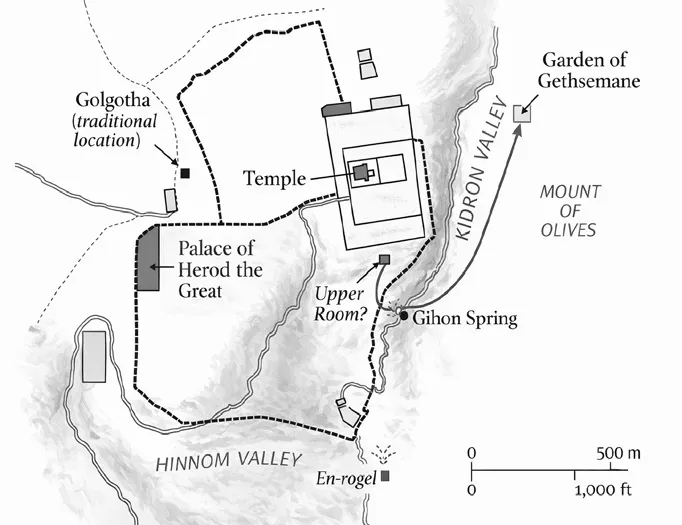
Jesus’ path from the Upper Room to the Garden of Gethsemane.
The Father carefully prunes fruitful branches to increase yield, showing that trials, correction, and spiritual discipline are part of God’s work in cultivating mature, fruitful disciples. Branches that do not abide are removed, illustrating the necessity of continued faith and obedience for spiritual life (vv. 1–2).
Jesus commands His disciples to love one another as He has loved them, connecting abiding in Him with ethical and relational expression. Obedience to His commandments flows from love and results in lasting fruitfulness, reflecting God’s glory to the world (vv. 3, 12).
Verses 4 and 5 form a parallel structure:
“⁴ Abide in me, and I in you.
As the branch cannot bear fruit by itself, unless it abides in the vine, neither can you, unless you abide in me.
⁵ I am the vine; you are the branches.
Whoever abides in me and I in him, he it is that bears much fruit, for apart from me you can do nothing.“
Jesus reassures His followers that they have been chosen to bear lasting fruit and that whatever they ask in His name will be granted, highlighting the relationship between divine purpose, prayer, and faithful discipleship (vv. 16–17).
Asking in Jesus’ Name (v. 16b)
Section titled “Asking in Jesus’ Name (v. 16b)”Asking in Jesus’ name does not mean we can request anything we desire. It means praying in line with His will and purposes. We are to seek what honours Him and advances His kingdom.
The World’s Hatred (15:18–27)
Section titled “The World’s Hatred (15:18–27)”The Hatred of the World
¹⁸ “If the world hates you, know that it has hated me before it hated you. ¹⁹ If you were of the world, the world would love you as its own; but because you are not of the world, but I chose you out of the world, therefore the world hates you. ²⁰ Remember the word that I said to you: ‘A servant is not greater than his master.’ If they persecuted me, they will also persecute you. If they kept my word, they will also keep yours.
²¹ But all these things they will do to you on account of my name, because they do not know him who sent me. ²² If I had not come and spoken to them, they would not have been guilty of sin, but now they have no excuse for their sin. ²³ Whoever hates me hates my Father also. ²⁴ If I had not done among them the works that no one else did, they would not be guilty of sin, but now they have seen and hated both me and my Father. ²⁵ But the word that is written in their Law must be fulfilled: ‘They hated me without a cause.’
²⁶ “But when the Helper comes, whom I will send to you from the Father, the Spirit of truth, who proceeds from the Father, he will bear witness about me. ²⁷ And you also will bear witness, because you have been with me from the beginning.”
Jesus warns His disciples that the world will hate them because they belong to Him, just as it rejected Him (v. 18). Believers are called to distinguish themselves from worldly values, living in obedience and love, which may provoke opposition. The hatred stems from the world’s alignment with evil and its rejection of God’s truth.
He comforts them by promising to send the Holy Spirit, the Helper (Paraklētos), who will testify about Him and empower the disciples to bear witness (vv. 16, 26). Persecution is inevitable for faithful discipleship, yet it is evidence of union with Christ and is met with divine guidance and support. This teaching underscores the tension between the believer and the world, showing that rejection is not personal but a response to allegiance to Jesus and His truth.
Preaching and Teaching the Word
Section titled “Preaching and Teaching the Word”The Vinedresser’s Care: Pruning and Lifting (15:1–3)
John 15:1–3 depicts God as the vinedresser, actively caring for His people. He prunes fruitful branches to increase their productivity, using trials and discipline for growth and holiness. This divine pruning is an expression of love, not displeasure, shaping believers to bear lasting fruit as they remain connected to Christ, the true vine.
“I am the True Vine” (15:1, 5)
Jesus declares, “I am the true vine, and my Father is the vinedresser… I am the vine; you are the branches. Whoever abides in me and I in him, he it is that bears much fruit” (vv. 1, 5). Spiritual life and fruitfulness depend on remaining connected to Christ. Apart from Him, we can do nothing, but abiding in His love produces lasting fruit that glorifies God and blesses others.
The Cost of Discipleship: Worldly Hatred (15:18–21)
Believers face worldly hatred because they are “chosen out of the world” (vv. 18–19). Following Christ means encountering the same opposition He endured (vv. 20–21). This persecution confirms true discipleship, reminding us that allegiance to Jesus sets us apart from the world and calls us to faithful endurance amid hostility.
John 16
Section titled “John 16”John 16 can be understood in two main sections: the work of the Holy Spirit and Jesus’ comforting assurances to His disciples. Jesus prepares them to face grief, confusion, and trials in life with faith, courage, and peace.
The theme of the Spirit develops from the symbolic promise of “water” (3:5) to the gift of the Helper (16:7). This “water” represents the Spirit’s purifying work, later described as “living water” (7:37–39) and ultimately revealed as the Spirit of Truth guiding believers (John 14–16).
The Role of the Holy Spirit (16:1–15)
Section titled “The Role of the Holy Spirit (16:1–15)”The Work of the Holy Spirit
¹ “I have said all these things to you to keep you from falling away.
² They will put you out of the synagogues. Indeed, the hour is coming when whoever kills you will think he is offering service to God. ³ And they will do these things because they have not known the Father, nor me. ⁴ But I have said these things to you, that when their hour comes you may remember that I told them to you. I did not say these things to you from the beginning, because I was with you. ⁵ But now I am going to him who sent me, and none of you asks me, ‘Where are you going?’ ⁶ But because I have said these things to you, sorrow has filled your heart. ⁷ Nevertheless, I tell you the truth: it is to your advantage that I go away, for if I do not go away, the Helper will not come to you. But if I go, I will send him to you. ⁸ And when he comes, he will convict the world concerning sin and righteousness and judgment:
⁹ concerning sin, because they do not believe in me; ¹⁰ concerning righteousness, because I go to the Father, and you will see me no longer;
¹¹ concerning judgment, because the ruler of this world is judged.
¹² “I still have many things to say to you, but you cannot bear them now. ¹³ When the Spirit of truth comes, he will guide you into all the truth, for he will not speak on his own authority, but whatever he hears he will speak, and he will declare to you the things that are to come. ¹⁴ He will glorify me, for he will take what is mine and declare it to you. ¹⁵ All that the Father has is mine; therefore I said that he will take what is mine and declare it to you.
Opposition from the world (vv. 1–5) necessitates power from above. Jesus explains that His departure is necessary for the coming of the Holy Spirit, the Helper (Paraklētos), who will guide the disciples into all truth and take the place of His physical presence, ensuring ongoing divine guidance and fellowship with God.
The Spirit’s work includes convicting the world regarding sin, righteousness, and judgment (v. 8), revealing the consequences of rejecting God and the need for repentance and faith. He will glorify Jesus by revealing His truth (vv. 13–14), helping the disciples understand His mission, teachings, and the significance of His death and resurrection (v. 15).
Jesus’ Assurance to His Disciples (16:16–33)
Section titled “Jesus’ Assurance to His Disciples (16:16–33)”Your Sorrow Will Turn into Joy
¹⁶ “A little while, and you will see me no longer; and again a little while, and you will see me.” ¹⁷ So some of his disciples said to one another, “What is this that he says to us, ‘A little while, and you will not see me, and again a little while, and you will see me’; and, ‘because I am going to the Father’?” ¹⁸ So they were saying, “What does he mean by ‘a little while’? We do not know what he is talking about.” ¹⁹ Jesus knew that they wanted to ask him, so he said to them, “Is this what you are asking yourselves, what I meant by saying, ‘A little while and you will not see me, and again a little while and you will see me’? ²⁰ Truly, truly, I say to you, you will weep and lament, but the world will rejoice. You will be sorrowful, but your sorrow will turn into joy. ²¹ When a woman is giving birth, she has sorrow because her hour has come, but when she has delivered the baby, she no longer remembers the anguish, for joy that a human being has been born into the world. ²² So also you have sorrow now, but I will see you again, and your hearts will rejoice, and no one will take your joy from you. ²³ In that day you will ask nothing of me. Truly, truly, I say to you, whatever you ask of the Father in my name, he will give it to you. ²⁴ Until now you have asked nothing in my name. Ask, and you will receive, that your joy may be full.
Sorrow Will Turn into Joy (vv. 16–24)
Section titled “Sorrow Will Turn into Joy (vv. 16–24)”When Jesus says, “A little while, and you will see me no longer; and again a little while, and you will see me” (v. 16), the phrase “a little while” is intentionally vague. He does not give a precise duration.
Historically, the first “little while” refers to the period between His arrest and crucifixion, when the disciples would no longer see Him (v. 17). The second “little while” refers to the time from His resurrection until His post-resurrection appearances, when they would see Him again (v. 19).
Jesus prepares His disciples for the grief they will experience at His impending departure, describing it as a brief period of sorrow that will give way to lasting joy (v. 20). He uses the metaphor of a woman in labour to illustrate the intensity of their current suffering and the certainty of its joyful resolution when His purpose is fulfilled (vv. 21–22).
The disciples are initially confused by His words, but Jesus reassures them that their pain will be transformed through His resurrection, which will bring the ultimate fulfilment of God’s plan. He emphasises the power of prayer in His name, promising that their requests aligned with His will be granted (vv. 23–24), linking obedience, faith, and participation in God’s work.
I Have Overcome the World
²⁵ “I have said these things to you in figures of speech. The hour is coming when I will no longer speak to you in figures of speech but will tell you plainly about the Father. ²⁶ In that day you will ask in my name, and I do not say to you that I will ask the Father on your behalf;
²⁷ for the Father himself loves you, because you have loved me and have believed that I came from God. ²⁸ I came from the Father and have come into the world, and now I am leaving the world and going to the Father.“
²⁹ His disciples said, “Ah, now you are speaking plainly and not using figurative speech! ³⁰ Now we know that you know all things and do not need anyone to question you; this is why we believe that you came from God.” ³¹ Jesus answered them, “Do you now believe? ³² Behold, the hour is coming, indeed it has come, when you will be scattered, each to his own home, and will leave me alone. Yet I am not alone, for the Father is with me. ³³ I have said these things to you, that in me you may have peace. In the world you will have tribulation. But take heart; I have overcome the world.”
I Have Overcome the World (vv. 25–33)
Section titled “I Have Overcome the World (vv. 25–33)”Jesus repeats “the hour is coming” (v. 25) to highlight the approaching time of His death, resurrection, and glorification. The repetition underscores the certainty and significance of this pivotal moment, preparing the disciples for the coming trials while assuring them of His victory and peace.
He concludes His Farewell Discourse by assuring His disciples that, though He has spoken in figurative language, the time will come when they will understand clearly that He has come from the Father (vv. 25–27). He emphasises that faith in Him grants access to the Father, promising that whatever is asked in His name will be given (vv. 28–30), linking trust, obedience, and divine provision.
He warns them of the coming tribulation, explaining that the world will hate His followers as it hated Him (vv. 31–32), yet He encourages them not to be discouraged. His declaration, “I have overcome the world” (v. 33), offers assurance that His death, resurrection, and ultimate victory secure peace and courage for His disciples.
Here lies the paradox of discipleship, where the certainty of trials coexists with the promise of Christ’s triumph, and abiding in Him ensures enduring peace, hope, and boldness in the face of adversity.
Preaching and Teaching the Word
Section titled “Preaching and Teaching the Word”The Ministry of the Holy Spirit (16:7–15)
Jesus promises that the Holy Spirit, the Helper, will replace His physical presence (v. 7). The Holy Spirit convicts the world (vv. 8–11), guides believers into all truth (v. 13), and reveals the things of Christ (vv. 14–15). His ministry is to glorify Jesus, calling us to depend on His guidance and live for Christ’s glory.
Asking in Jesus’ Name (16:23–24)
One of the gifts Jesus provides for His disciples is communication with God. Prayer is a relationship with God the Father, secured by the work of God the Son, and facilitated by the ministry of God the Spirit. Thus, when Jesus refers to prayer “in my name” (v. 24), He is speaking of the Trinitarian nature of prayer. To pray “in Jesus’ name” is to pray by means of the access that Christ alone provides and to pray under His authority. It is also to pray “in the Spirit,” since the Spirit facilitates and empowers our prayers, at times even speaking on our behalf. Why does our flesh make prayer a burden rather than a privilege?
Peace in Christ’s Victory (16:33)
Jesus declares, “Take heart; I have overcome the world” (v. 33). In a world of trouble, He offers a peace not shaped by circumstances but grounded in His victory. This triumphant conclusion calls believers to courage, trusting that Christ has already secured victory over the world’s power.
John 17
Section titled “John 17”John 17 serves as a conclusion to the Farewell Discourse. After gathering His disciples and addressing them privately, Jesus offers a closing prayer to the Father. The prayer can be divided into three parts: Jesus prays to be glorified; Jesus prays that His present disciples would be sanctified; and Jesus prays that His future disciples would be unified.
The Prayer of Jesus (17:1–26)
Section titled “The Prayer of Jesus (17:1–26)”The High Priestly Prayer
¹ When Jesus had spoken these words, he lifted up his eyes to heaven, and said, “Father, the hour has come; glorify your Son that the Son may glorify you, ² since you have given him authority over all flesh, to give eternal life to all whom you have given him. ³ And this is eternal life, that they know you, the only true God, and Jesus Christ whom you have sent. ⁴ I glorified you on earth, having accomplished the work that you gave me to do. ⁵ And now, Father, glorify me in your own presence with the glory that I had with you before the world existed.
⁶ “I have manifested your name to the people whom you gave me out of the world. Yours they were, and you gave them to me, and they have kept your word. ⁷ Now they know that everything that you have given me is from you. ⁸ For I have given them the words that you gave me, and they have received them and have come to know in truth that I came from you; and they have believed that you sent me. ⁹ I am praying for them. I am not praying for the world but for those whom you have given me, for they are yours. ¹⁰ All mine are yours, and yours are mine, and I am glorified in them. ¹¹ And I am no longer in the world, but they are in the world, and I am coming to you. Holy Father, keep them in your name, which you have given me, that they may be one, even as we are one. ¹² While I was with them, I kept them in your name, which you have given me. I have guarded them, and not one of them has been lost except the son of destruction, that the Scripture might be fulfilled.
¹³ But now I am coming to you, and these things I speak in the world, that they may have my joy fulfilled in themselves. ¹⁴ I have given them your word, and the world has hated them because they are not of the world, just as I am not of the world. ¹⁵ I do not ask that you take them out of the world, but that you keep them from the evil one. ¹⁶ They are not of the world, just as I am not of the world. ¹⁷ Sanctify them in the truth; your word is truth. ¹⁸ As you sent me into the world, so I have sent them into the world. ¹⁹ And for their sake I consecrate myself, that they also may be sanctified in truth.
²⁰ “I do not ask for these only, but also for those who will believe in me through their word, ²¹ that they may all be one, just as you, Father, are in me, and I in you, that they also may be in us, so that the world may believe that you have sent me. ²² The glory that you have given me I have given to them, that they may be one even as we are one, ²³ I in them and you in me, that they may become perfectly one, so that the world may know that you sent me and loved them even as you loved me. ²⁴ Father, I desire that they also, whom you have given me, may be with me where I am, to see my glory that you have given me because you loved me before the foundation of the world. ²⁵ O righteous Father, even though the world does not know you, I know you, and these know that you have sent me. ²⁶ I made known to them your name, and I will continue to make it known, that the love with which you have loved me may be in them, and I in them.”
The High Priestly Prayer (vv. 1–26)
Section titled “The High Priestly Prayer (vv. 1–26)”In v. 1, Jesus mentions for the third and final time, “the hour has come” (previously in 12:23; 13:1).
Jesus prays on three levels, structured like concentric circles. He prays for Himself first, asking the Father to glorify Him so that He may complete His redemptive work (vv. 1–5). He then prays for His disciples, seeking their protection, sanctification, and unity (vv. 6–19). Finally, He prays for all future believers, that they may be one, bear witness to the world, and share in His glory and love (vv. 20–26).
Jesus Prays for Himself (vv. 1–5)
Section titled “Jesus Prays for Himself (vv. 1–5)”When Jesus prays for Himself in vv. 1–5, He speaks of glory, eternal life, and the completion of His work. These themes echo the Gospel’s portrayal of Jesus’ mission from the beginning. Glory has already been revealed in the signs (vv. 2–3) and now reaches its climax in the cross (v. 4). Eternal life, consistently described in John as knowing the Father through the Son (vv. 3–4), is reaffirmed as relational rather than merely future. The declaration that His work is finished anticipates the cross and interprets it as the fulfilment of the Father’s will (vv. 4–5).
Jesus Prays for His Disciples (vv. 6–19)
Section titled “Jesus Prays for His Disciples (vv. 6–19)”When Jesus prays for His disciples in vv. 6–19, He draws directly on themes from the Farewell Discourses. He has revealed the Father to them (vv. 6–8), just as John shows that seeing the Son is seeing the Father. The disciples are portrayed as those given by the Father (vv. 9–10). Jesus prays for their protection in a hostile world (vv. 11–12), reflecting the Gospel’s repeated contrast between believers and the world. Their sanctification in truth (vv. 13–17) and their sending into the world (vv. 18–19) continue the pattern of discipleship and mission that mirrors Jesus’ own sending by the Father.
Jesus Prays for Those Who Will Believe (vv. 20–26)
Section titled “Jesus Prays for Those Who Will Believe (vv. 20–26)”When Jesus prays for future believers in vv. 20–26, the focus shifts to unity, love, and witness (vv. 20–21). This unity reflects the oneness between the Father and the Son and fulfils Jesus’ earlier teaching that love would mark true discipleship (vv. 22–23). The purpose of this unity is missionary, so that the world may believe (v. 23). The sharing of glory and love with believers completes the movement of the Gospel, as what belonged to the Son is now extended to those who believe (vv. 24–26).
Preaching and Teaching the Word
Section titled “Preaching and Teaching the Word”The High Priestly Prayer of Jesus (John 17)
Jesus’ High Priestly Prayer shows His heart for Himself, His disciples, and all believers. He first prays for Himself, asking the Father to glorify Him so that He may complete His mission (vv. 1–5). He then intercedes for His disciples, praying for their protection, sanctification, and unity (vv. 6–19). Finally, He prays for all who will believe in Him, desiring that they share His love, remain in God’s truth, and experience oneness with each other and with the Father (vv. 20–26). This prayer calls believers to trust Christ’s intercession and to live in His mission.
Protection and Spiritual Security (17:11–15)
Jesus prays that the Father will “keep” His disciples in His name (v. 11) and guard them from the evil one (v. 15). Though they face the world’s hostility (v. 14), believers remain secure through God’s power and Christ’s intercession. This assurance calls us to trust in His preserving grace.
The Power of Unity (17:11, 20–23)
Jesus prays that His followers may be one, just as He and the Father are one (vv. 11, 20–21). This unity becomes a powerful witness to the world (vv. 21, 23), displaying God’s love and confirming that the Son was sent, calling believers to visible, Christ-centred oneness.