Part 1 01 — John and the Synoptic Gospels
John and the Synoptic Gospels
Section titled “John and the Synoptic Gospels”And since all [i.e., all four canonical Gospels] had the same object, to show Christ, the first three exhibit His body, if I may be permitted to put it like that, but John shows His soul. (John Calvin, 1553)
Reading the Gospels in biblical order, John’s Gospel immediately feels different. Its narratives, chronology, and language set it apart. Matthew, Mark, and Luke are called the Synoptic Gospels because they share a common view of Jesus. John, however, offers a distinct perspective. He omits much of what the others include, not out of ignorance, but by intention. Writing with a different purpose, John presents Jesus from another angle, inviting readers to see not less, but deeper.
Additional Materials
Section titled “Additional Materials”The additional materials in John’s Gospel include five of the seven miracles (excluding the feeding of the multitude and the walking on water), the early Galilean ministry (Cana), the journey through Samaria (the woman at the well), the washing of the disciples’ feet, the farewell discourses, three trips to Jerusalem, and more.
Missing Materials
Section titled “Missing Materials”There is no mention of the virgin birth, baptism of Jesus, temptation of Jesus, transfiguration, parables, institution of the Lord’s Supper, cure of demoniacs and lepers, and more.
Different Chronology
Section titled “Different Chronology”John’s Gospel presents an early cleansing of the Temple, points to a public ministry lasting about three years rather than a single year, and describes the final meal as a Last Supper rather than a Passover meal.
Author, Recipients, Date, and Occasion
Section titled “Author, Recipients, Date, and Occasion”Author
Section titled “Author”The authorship of John’s Gospel has been widely debated. While the traditional view attributes it to the Apostle John, modern scholarship has questioned this claim, proposing alternatives such as authorship by a Johannine community or by John the Elder.
In recent decades, the Johannine community model has come under significant criticism and is increasingly viewed as speculative and historically weak.
Despite the Gospel’s anonymity and deliberate obscuring of authorship, its theological and historical credibility remain strong. Its acceptance into the Christian canon suggests early recognition of apostolic authority, making John, the son of Zebedee, a plausible author.
The traditional view of the authorship of John’s Gospel has been that John, “the beloved disciple,” wrote the book. Both internal and external evidence support the claim that the apostle John wrote the Gospel.
Internal Evidence
Section titled “Internal Evidence”Internal evidence suggests that the author was a Jew with a deep knowledge of the Old Testament, quoting Scripture (6:45; 13:18; 19:37) and demonstrating familiarity with Jewish customs and traditions (2:6; 5:1; 10:22). He also shows an intimate knowledge of the geography of Palestine and presents himself as an eyewitness to the events he records.
The author identifies himself as the apostle known as the Beloved Disciple (21:20, 24), who reclined on Jesus’ breast at the Last Supper. He belonged to Jesus’ inner circle along with Peter and James. Since James had been martyred before the Gospel was written (Acts 12:1–5) and Peter is portrayed as distinct from the Beloved Disciple (21:7), the evidence points to John as the sole author.
External Evidence
Section titled “External Evidence”External evidence from the time of the church fathers reflects an early belief that the apostle John wrote the Gospel. Irenaeus (AD 120-202) wrote:
Afterwards, John, the disciple of the Lord, who also had leaned upon His breast, did himself publish a gospel during his residence at Ephesus in Asia (Against Heresies 3.1.1.).
As for the reliability of Irenaeus, Eusebius says his authority was Polycarp (c. AD 69-155), who had personally heard the apostle (Eccl. Hist. 4.14).
Theophilus of Antioch (c. AD 115-185), Clement of Alexandria (c. AD 150-215), Origen (c. AD 185-254), Hippolytus (c. AD 170-235), Tertullian (c. AD 155-220), and the Muratorian Fragment (c. AD 170-180) agree in attributing the Gospel to John, the son of Zebedee.
Recipients
Section titled “Recipients”The Gospel was most likely written in Ephesus and intended for a broad audience. Early church testimony strongly supports an Ephesian origin. The readership appears to have been diverse, including Jewish and Gentile Christians, as well as non-believers.
The Gospel addresses readers both familiar and unfamiliar with Jewish customs, often explaining first-century Jewish practices and social boundaries. This indicates the author’s sensitivity to cultural diversity and missionary intent. Overall, the Gospel aims to introduce Jesus to outsiders and deepen the faith of believers.
Date and Occasion
Section titled “Date and Occasion”The Gospel was probably written after the destruction of the Jerusalem Temple in AD 70, an event that reshaped Jewish religious life, resulting in the separation between synagogue Judaism and Jewish Christianity. This historical context explains the Gospel’s theological emphasis on Jesus as the new focal point of worship and revelation.
The text was likely composed over time and completed toward the end of the first century. Most scholars date its final form to around AD 85, during a period when Christian identity had become distinct and increasingly inclusive of Gentiles.
The events of the Gospel of John took place in Palestine, which was incorporated into the Roman Empire in 63 BC. Herod the Great was installed by the Romans as king of the Jews in 37 BC. He ruled until he died in 4 BC. After he died, the Romans divided Herod’s kingdom among his sons. Archelaus was appointed ethnarch over Judea, Samaria, and Idumea, Antipas became tetrarch of Galilee and Perea, and Philip was made tetrarch of the northeastern territories.
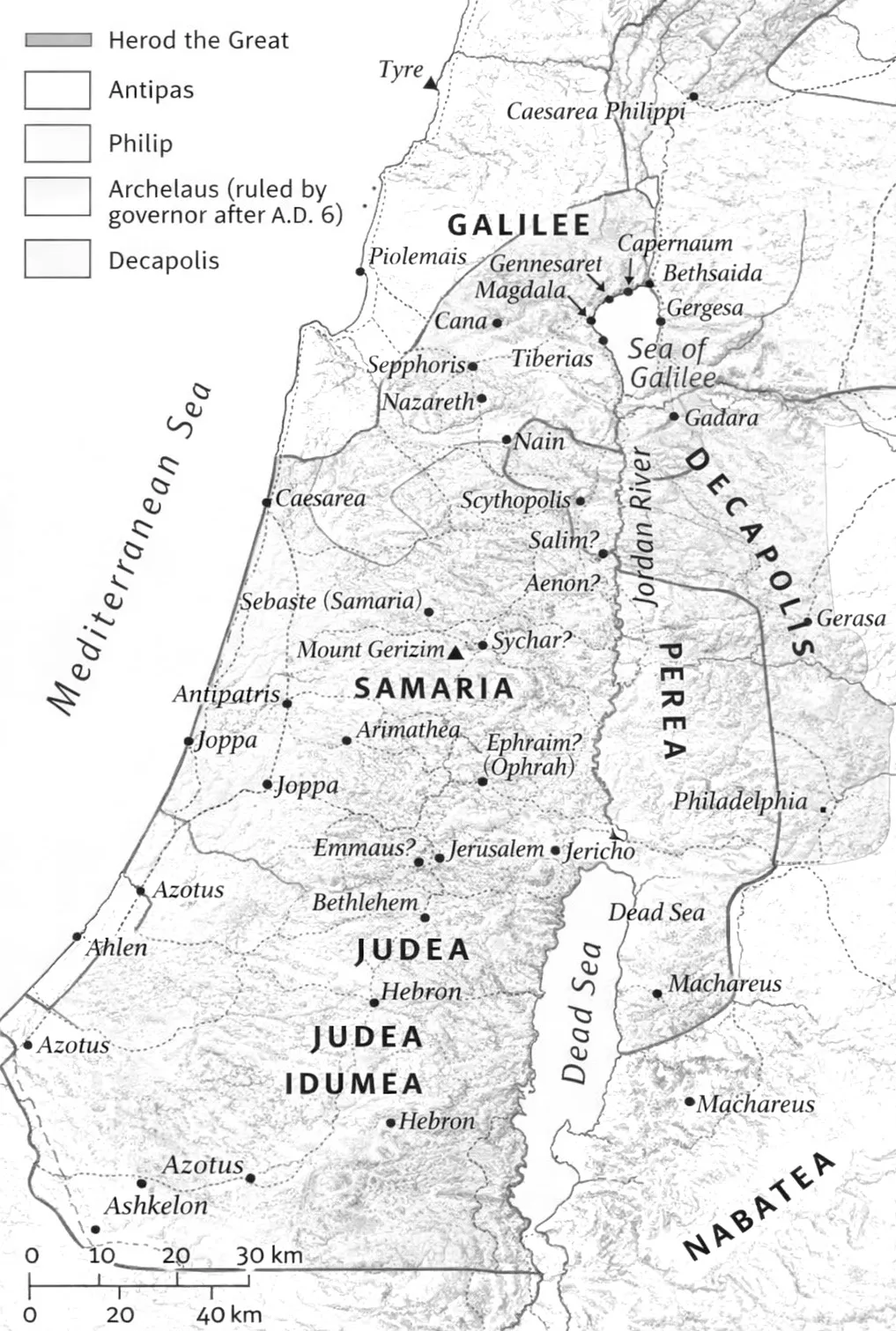
Kingdom of Herod the Great at his death c. 4 BC
Purpose
Section titled “Purpose”John opens his Gospel with a soaring theological declaration: “In the beginning was the Word, and the Word was with God, and the Word was God” (John 1:1). This opening frames Jesus not merely as a teacher or miracle worker but as the eternal Son who fully reveals God.
John is intentionally selective in what to include in the Gospel. As he explains, these accounts “are written so that you may believe that Jesus is the Christ” (20:31). His aim is not completeness but conviction by presenting signs, teachings, and encounters that lead the reader to a transforming faith.
The Manuscript Evidence for the Gospel of John
Section titled “The Manuscript Evidence for the Gospel of John”D. A. Carson nicely summarizes the Greek manuscripts of John:
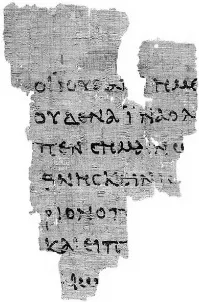
The earliest New Testament fragment known to us is the fragment of John, p52, dating from about A.D. 130 and containing a few words from John 18. Two other papyrus witnesses, both codices, spring from the end of the second century: p66 includes most of John 1-14 and parts of the remaining chapters, while p75 contains most of Luke, followed by John 1-11 and parts of chapter 12-15. From the beginning of the third century comes p45, which contains parts of all four Gospels plus Acts, though the mutilated state of the manuscript ensures that no book is complete. Thereafter the manuscript evidence becomes richer, capped by the great fourth-century uncials (manuscripts written in capital letters) and followed by the many minuscules in succeeding centuries. ¹
The oldest known papyrus fragment of the New Testament is the Rylands Library Papyrus P52 from the Gospel of John 18:31-33, dated to the early second century, possibly only about fifty years after it was written. This fragment, acquired in 1920 in Egypt, is now housed in the John Rylands Library, Manchester, England.