Part 3 01 — The Foot Washing, the Betrayal, and the New Commandment
The Foot Washing, the Betrayal, and the New Commandment
Section titled “The Foot Washing, the Betrayal, and the New Commandment”(13:1–38)
At the end of the Book of Signs (12:23), and at the beginning of the Book of Glory, Jesus actively hastens towards the cross as the goal of His mission. John 13, therefore, marks the transition to the “Book of Glory,” where Jesus’ “hour” arrives, shifting from public signs to private ministry with His disciples.
John 13
Section titled “John 13”The anticipated hour of Jesus in the Gospel has come at last. After setting the stage in the previous chapter for His coming death, this chapter presents a symbolic action that foreshadows His death through the washing of the disciples’ feet and models the servant heart they are to follow. He predicts His betrayal and calls them to a new commandment: to love one another as He has loved them.
The Foot Washing (13:1–20)
Section titled “The Foot Washing (13:1–20)”Jesus Washes the Disciples’ Feet
¹ Now before the Feast of the Passover, when Jesus knew that his hour had come to depart out of this world to the Father, having loved his own who were in the world, he loved them to the end. ² During supper, when the devil had already put it into the heart of Judas Iscariot, Simon’s son, to betray him, ³ Jesus, knowing that the Father had given all things into his hands, and that he had come from God and was going back to God, ⁴ rose from supper. He laid aside his outer garments, and taking a towel, tied it around his waist. ⁵ Then he poured water into a basin and began to wash the disciples’ feet and to wipe them with the towel that was wrapped around him. ⁶ He came to Simon Peter, who said to him, “Lord, do you wash my feet?” ⁷ Jesus answered him, “What I am doing you do not understand now, but afterward you will understand.”
⁸ Peter said to him, “You shall never wash my feet.” Jesus answered him, “If I do not wash you, you have no share with me.” ⁹ Simon Peter said to him, “Lord, not my feet only but also my hands and my head!” ¹⁰ Jesus said to him, “The one who has bathed does not need to wash, except for his feet, but is completely clean. And you are clean, but not every one of you.” ¹¹ For he knew who was to betray him; that was why he said, “Not all of you are clean.”
¹² When he had washed their feet and put on his outer garments and resumed his place, he said to them, “Do you understand what I have done to you? ¹³ You call me Teacher and Lord, and you are right, for so I am. ¹⁴ If I then, your Lord and Teacher, have washed your feet, you also ought to wash one another’s feet. ¹⁵ For I have given you an example, that you also should do just as I have done to you. ¹⁶ Truly, truly, I say to you, a servant is not greater than his master, nor is a messenger greater than the one who sent him. ¹⁷ If you know these things, blessed are you if you do them. ¹⁸ I am not speaking of all of you; I know whom I have chosen. But the Scripture will be fulfilled, ‘He who ate my bread has lifted his heel against me.’ ¹⁹ I am telling you this now, before it takes place, that when it does take place you may believe that I am he. ²⁰ Truly, truly, I say to you, whoever receives the one I send receives me, and whoever receives me receives the one who sent me.”
The Hour Has Come (v. 1)
Section titled “The Hour Has Come (v. 1)”In John 13–19, we are dealing with the twenty-four hours before the start of the Sabbath, which began on Friday evening at sunset. After anticipating the “hour” of Jesus (2:4; 7:30; 8:20), John now reveals that the “hour” has come and that the Feast of the Passover is near (v. 1). Jesus gathers His disciples in the Upper Room for the Last Supper.
Foot Washing Hospitality
Section titled “Foot Washing Hospitality”In first-century Israel, people commonly wore open sandals and walked along dusty roads. As a result, washing one’s feet upon entering a home for a meal was a basic act of cleanliness and hospitality. At the Last Supper, no servant was present to perform this task. Jesus assumed this role, demonstrating humble, self-giving love (vv. 4–5).
Jesus set this act as an example for His disciples, calling them to follow His pattern of humble service: “For I have given you an example, that you also should do just as I have done to you” (v. 15).
In some Christian traditions, this practice is commemorated in foot-washing services on Maundy Thursday. Jesus washed the feet of all His disciples, including Judas, who would betray Him (vv. 2, 11). His act demonstrates unconditional love that extends even to one’s enemies.
The Water Motif
Section titled “The Water Motif”The water motif, seen earlier in the Gospel, resurfaces one last time before the crucifixion in a symbolic act of washing the disciples’ feet.
Besides serving as an example of humble service, the foot washing on the night before Passover also functions as a theological interpretation of Jesus’ death. The basin, towel, and water together form a visible sign of what Jesus is about to accomplish through the cross (vv. 4–5).
Peter’s protest brings the meaning of the action into focus. His refusal, followed by his request for complete washing, reveals a misunderstanding of both the nature and purpose of Jesus’ act (vv. 6–8). Jesus clarifies the distinction between those who have already undergone full bathing and those who require only their feet to be washed (vv. 9–10). This reflects Jewish purity customs linked to Passover, in which ritual immersion preceded the meal, yet additional washing was still necessary.
John seems to assume that the disciples have performed the immersion ritual before participating in the Last Supper (v. 10). Such immersion was required before a Passover meal. According to Instone-Brewer, to eat the Passover, one had to be in a state of purity. Hence, it was customary for everyone to immerse before eating the Passover, just in case someone contracted impurity.¹
This is the only time Jesus is involved in a ritual cleansing for His disciples. Jesus insists that accepting the washing is necessary to have a share with Him (v. 8). The foot washing thus anticipates the cleansing that will come through His death.
As earlier water imagery in the Gospel gives way to fulfilment, this final act prepares the reader for the cross, where water and blood will flow from Jesus’ side (19:34).
The Betrayal (13:21–30)
Section titled “The Betrayal (13:21–30)”One of You Will Betray Me
²¹ After saying these things, Jesus was troubled in his spirit, and testified, “Truly, truly, I say to you, one of you will betray me.” ²² The disciples looked at one another, uncertain of whom he spoke. ²³ One of his disciples, whom Jesus loved, was reclining at table at Jesus’ side, ²⁴ so Simon Peter motioned to him to ask Jesus of whom he was speaking. ²⁵ So that disciple, leaning back against Jesus, said to him, “Lord, who is it?” ²⁶ Jesus answered, “It is he to whom I will give this morsel of bread when I have dipped it.” So when he had dipped the morsel, he gave it to Judas, the son of Simon Iscariot. ²⁷ Then after he had taken the morsel, Satan entered into him. Jesus said to him, “What you are going to do, do quickly.” ²⁸ Now no one at the table knew why he said this to him. ²⁹ Some thought that, because Judas had the moneybag, Jesus was telling him, “Buy what we need for the feast,” or that he should give something to the poor. ³⁰ So, after receiving the morsel of bread, he immediately went out. And it was night.
During the Last Supper, Jesus becomes troubled in spirit and reveals that one of His disciples will betray Him, creating tension and prompting confusion among the Twelve (v. 21). Before this revelation, Jesus had already washed Judas’ feet, demonstrating foreknowledge. Each disciple questions whether he is the one (v. 22).
He identifies Judas Iscariot, not by public accusation but through a subtle instruction, giving him a morsel of bread, an act that signals both intimacy and judgment (vv. 26–27). Judas immediately departs to execute the betrayal (v. 30).
This passage prepares the disciples and readers for the unfolding Passion, showing that betrayal and suffering are integral to the fulfilment of God’s salvation purpose.
The Seating Arrangement
Section titled “The Seating Arrangement”Jesus and His disciples, living in the days of the Roman Empire, shared the Last Supper reclining together on couches, leaning towards one another. Verse 23 tells us that the disciple whom Jesus loved (John) was reclining (anakeimenos) at the table at Jesus’ side (v. 23).
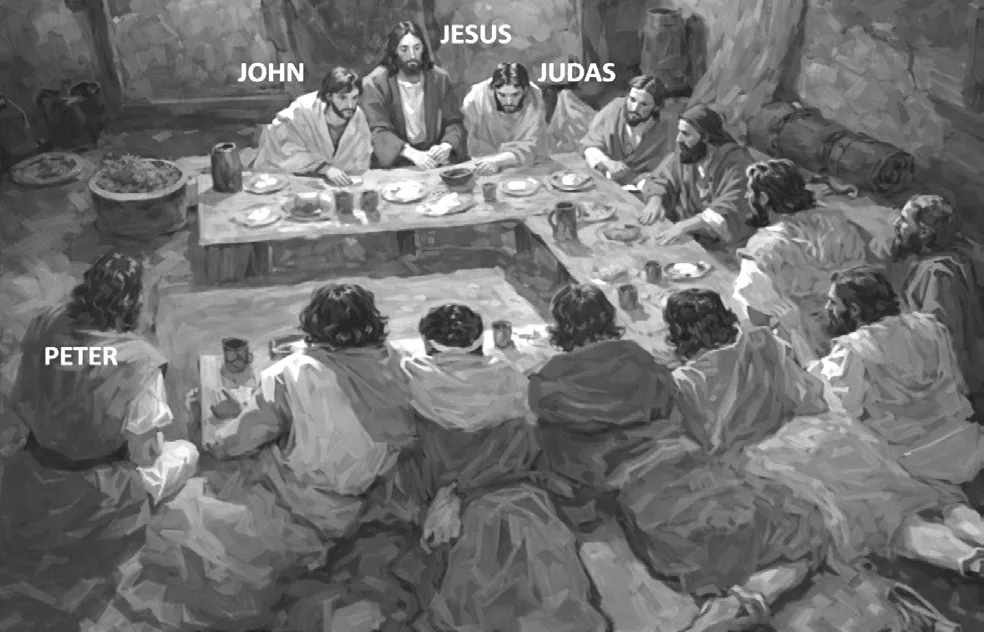
Jewish diners in Jerusalem, influenced by Roman customs, commonly used the triclinium style: a U-shaped table with couches along three sides, where guests reclined on their left side and ate with their right hand.
Jesus, as host, occupied the central position on the left side. To His right sat John, leaning on Jesus’ chest (v. 25). To Jesus’ left, in the seat of honour, sat Judas, close enough to dip bread from the same bowl (v. 26).
Peter reclined across from John, which is why he signalled for John to ask Jesus who the betrayer was (v. 24). Peter’s, John’s, and Judas’ seating arrangements underscore the contrasts of loyalty, betrayal, and the deep personal relationships surrounding Jesus.
The New Commandment and Peter’s Denials Foretold (13:31–38)
Section titled “The New Commandment and Peter’s Denials Foretold (13:31–38)”A New Commandment
³¹ When he had gone out, Jesus said, “Now is the Son of Man glorified, and God is glorified in him. ³² If God is glorified in him, God will also glorify him in himself, and glorify him at once. ³³ Little children, yet a little while I am with you. You will seek me, and just as I said to the Jews, so now I also say to you, ‘Where I am going you cannot come.’
³⁴ A new commandment I give to you, that you love one another: just as I have loved you, you also are to love one another. ³⁵ By this all people will know that you are my disciples, if you have love for one another.“
The Fourth Monologue: The Farewell Discourse (13:31–16:33)
Section titled “The Fourth Monologue: The Farewell Discourse (13:31–16:33)”In this section of John’s Gospel, the Farewell Discourse, Jesus prepares His disciples for His departure, promising the Holy Spirit, teaching them about love, obedience, and peace, and assuring them that, despite trials, faith in Him secures eternal life and divine guidance.
After Judas departs to carry out his betrayal (v. 30), Jesus commences His Farewell Discourse (v. 31). He gives them a “new commandment,” that they love one another: “just as I have loved you, you also are to love one another” (v. 34). This love is distinguished by self-sacrifice, humility, and practical service, reflecting the same love that Jesus demonstrates in His impending death.
By linking love to His glorification (vv. 31–32), Jesus redefines the disciples’ identity and witness. Their love for one another becomes the distinguishing mark of true discipleship and a visible testament to God’s presence in the world: “By this all people will know that you are my disciples, if you have love for one another” (v. 35).
Jesus Foretells Peter’s Denial
³⁶ Simon Peter said to him, “Lord, where are you going?” Jesus answered him, “Where I am going you cannot follow me now, but you will follow afterward.” ³⁷ Peter said to him, “Lord, why can I not follow you now? I will lay down my life for you.” ³⁸ Jesus answered, “Will you lay down your life for me? Truly, truly, I say to you, the rooster will not crow till you have denied me three times.”
Jesus Foretells Peter’s Denial (vv. 36–38)
Section titled “Jesus Foretells Peter’s Denial (vv. 36–38)”Following His instruction on love, Jesus turns to Peter, who confidently declares his willingness to follow Him even to death: “Lord, why can I not follow you now? I will lay down my life for you” (v. 37). Jesus responds with a solemn prediction: “Will you lay down your life for me? Truly, truly, I say to you, the rooster will not crow till you have denied me three times” (v. 38).
This moment exposes the tension between human confidence and spiritual weakness, illustrating that loyalty must be grounded in reliance on God rather than self-assurance. Jesus’ foreknowledge of Peter’s failure highlights His divine insight; yet it does not compel Peter’s choice. Rather, it reveals the vulnerability of human devotion and the necessity of grace.
Preaching and Teaching the Word
Section titled “Preaching and Teaching the Word”Communion Meditation (13:7–10, 14–15)
John 13:7–10, 14–15 points to Christ’s cleansing work, making it ideal for Communion Sunday. His sacrificial death, “Behold, the Lamb of God, who takes away the sin of the world!” (1:29), is remembered through the bread and wine: “This is my body, which is for you. Do this in remembrance of me” (1 Cor 11:24). His example of service also calls us to love one another, symbolised by the towel and basin. Communion unites us vertically with God and horizontally with fellow disciples in Christ.
The Love Commandment (13:34)
On Maundy Thursday, Jesus gives the love commandment: “A new commandment I give to you, that you love one another: just as I have loved you, you also are to love one another” (v. 34). He further declares, “By this all people will know that you are my disciples, if you have love for one another” (v. 35). This love mirrors His sacrificial example, marks His disciples, and calls believers to live out tangible, selfless care for others. Obedience to Christ is expressed not in words alone but in practical, Christ-like love.
Two Basins (13:5)
The two basins of the Passion reveal contrasting hearts. Pilate washes his hands, claiming innocence: “I am innocent of this man’s blood; see to it yourselves” (Matt 27:24), thus protecting his reputation yet remaining guilty. Jesus takes a basin to wash His disciples’ feet (vv. 4–5), exemplifying sacrificial love and obedience. These basins challenge believers to choose between self-preservation and humble service, following Christ’s model of self-giving love.