Part 2 04 — Introducing the Passion
Introducing the Passion
Section titled “Introducing the Passion”(11:1–12:50)
John 11–12 ushers in the Passion, revealing Jesus’ glory through suffering. The raising of Lazarus demonstrates His authority over death, while the anointing and triumphal entry honour Him yet foreshadow rejection. These chapters serve as a bridge to the cross, showing that true glory lies not in power but in sacrificial love, preparing readers for the ultimate revelation of divine love in the crucifixion and resurrection.
John 11
Section titled “John 11”This chapter recounts Jesus raising Lazarus from the dead, marking His seventh sign miracle. Within the chapter, He declares the fifth “I Am” saying: “I am the resurrection and the life” (v. 25). This moment reveals His authority over death, His compassion, and the promise of eternal life for all who believe.
Places and People Profile
Section titled “Places and People Profile”Places Profile
Section titled “Places Profile”- Bethany: Located on the east side of the Mount of Olives, about two miles southeast of Jerusalem. It was the hometown of Mary, Martha, and Lazarus. Bethany lies in the general area where the ascension of Jesus took place.
- Ephraim: A city named for the younger of Joseph’s two sons. It is most likely identified with the modern-day village of Taybeh, approximately ten miles northeast of Jerusalem.
People Profile
Section titled “People Profile”- Lazarus: Brother of Mary and Martha, resident of Bethany. He is mentioned only here and in John 12.
- Mary: The name of at least five women in the New Testament. This chapter introduces Mary of Bethany, who is also mentioned in John 12. She is commended for her personal worship.
- Martha: Hosted Jesus in her home. She grieved for her dead brother, Lazarus, along with her sister Mary, and proclaimed her faith in the resurrection (11:27).
- Thomas: One of the original twelve disciples. He is mentioned three times in John’s Gospel (11:16; 20:24; 21:2) and proclaimed the deity of Jesus after Jesus’ second resurrection appearance to the disciples. Tradition suggests that Thomas later served as a missionary in Carthia, Persia, and India.
- Caiaphas: Held the office of high priest from AD 18 to 36. He was the son-in-law of Annas, who was appointed high priest in AD 7. Caiaphas presided over the second trial of Jesus (18:24).
The Seventh Sign: The Raising of Lazarus (11:1–44)
Section titled “The Seventh Sign: The Raising of Lazarus (11:1–44)”The Death of Lazarus
1 Now a certain man was ill, Lazarus of Bethany, the village of Mary and her sister Martha. 2 It was Mary who anointed the Lord with ointment and wiped his feet with her hair, whose brother Lazarus was ill. 3 So the sisters sent to him, saying, “Lord, he whom you love is ill.”
4 But when Jesus heard it he said, “This illness does not lead to death. It is for the glory of God, so that the Son of God may be glorified through it.”
5 Now Jesus loved Martha and her sister and Lazarus. 6 So, when he heard that Lazarus was ill, he stayed two days longer in the place where he was. 7 Then after this he said to the disciples, “Let us go to Judea again.” 8 The disciples said to him, “Rabbi, the Jews were just now seeking to stone you, and are you going there again?” 9 Jesus answered, “Are there not twelve hours in the day? If anyone walks in the day, he does not stumble, because he sees the light of this world. 10 But if anyone walks in the night, he stumbles, because the light is not in him.” 11 After saying these things, he said to them, “Our friend Lazarus has fallen asleep, but I go to awaken him.” 12 The disciples said to him, “Lord, if he has fallen asleep, he will recover.” 13 Now Jesus had spoken of his death, but they thought that he meant taking rest in sleep. 14 Then Jesus told them plainly, “Lazarus has died, 15 and for your sake I am glad that I was not there, so that you may believe. But let us go to him.” 16 So Thomas, called the Twin, said to his fellow disciples, “Let us also go, that we may die with him.”
This narrative occurs at a critical point in John’s Gospel, as opposition to Jesus in Judea grows. The illness and death of Lazarus in Bethany prepare the way for Jesus’ most remarkable sign, demonstrating His authority over death. By delaying His return despite the risk, Jesus shows that Lazarus’s death serves God’s glory and deepens the disciples’ faith.
The Death of Lazarus (vv. 1–16)
Section titled “The Death of Lazarus (vv. 1–16)”The brother of Mary and Martha lies gravely ill (vv. 1–3). Jesus’ response is striking. He delays His journey to Bethany and explains that the sickness will not end in death but will serve to glorify God and reveal the Son of God (v. 4). This moment highlights a central theme in John: God’s glory is revealed through Jesus’ actions, often in unexpected ways. When He finally sets out (vv. 7–10), His disciples fear for His safety (v. 8). Jesus assures them that Lazarus will rise again (vv. 11, 23), pointing forward to both physical resurrection and the ultimate victory over death through His own work. Despite the delay (v. 6), Jesus moves intentionally toward the crisis, demonstrating divine sovereignty and perfect timing in God’s redemptive plan. The disciples’ confusion, especially Thomas’ resolve to follow Jesus even to death (v. 16), reveals the tension between fear, faith, and limited understanding.
In this way, John prepares the reader for the climactic revelation of Jesus’ power over death, setting the stage for the display of God’s glory in the raising of Lazarus.
I Am the Resurrection and the Life
17 Now when Jesus came, he found that Lazarus had already been in the tomb four days. 18 Bethany was near Jerusalem, about two miles off, 19 and many of the Jews had come to Martha and Mary to console them concerning their brother. 20 So when Martha heard that Jesus was coming, she went and met him, but Mary remained seated in the house. 21 Martha said to Jesus, “Lord, if you had been here, my brother would not have died. 22 But even now I know that whatever you ask from God, God will give you.” 23 Jesus said to her, “Your brother will rise again.” 24 Martha said to him, “I know that he will rise again in the resurrection on the last day.” 25 Jesus said to her, “I am the resurrection and the life. Whoever believes in me, though he die, yet shall he live, 26 and everyone who lives and believes in me shall never die. Do you believe this?” 27 She said to him, “Yes, Lord; I believe that you are the Christ, the Son of God, who is coming into the world.”
Jesus the Resurrection and the Life (vv. 17–27)
Section titled “Jesus the Resurrection and the Life (vv. 17–27)”When Jesus arrives in Bethany, Lazarus has already been in the tomb for four days. Martha meets Him and expresses both grief and faith, affirming that if Jesus had been present, her brother would not have died.
The Fifth “I Am” Saying: “I am the Resurrection and the Life” (v. 25)
Section titled “The Fifth “I Am” Saying: “I am the Resurrection and the Life” (v. 25)”In His fifth “I Am” saying, Jesus declares, “I am the resurrection and the life” (v. 25), revealing His power over death and His promise of eternal life for all who believe in Him.
This statement shifts the focus from temporal life to eternal life, showing that faith in Him transcends physical death (vv. 25–26). Jesus invites Martha to trust in His power and in God’s plan, linking belief in Him with participation in God’s life-giving work (vv. 25–27). Her confession, “Yes, Lord; I believe that you are the Christ, the Son of God” (v. 27), acknowledges both His messianic identity and His divine authority over life and death.
Jesus Weeps
28 When she had said this, she went and called her sister Mary, saying in private, “The Teacher is here and is calling for you.” 29 And when she heard it, she rose quickly and went to him. 30 Now Jesus had not yet come into the village, but was still in the place where Martha had met him. 31 When the Jews who were with her in the house, consoling her, saw Mary rise quickly and go out, they followed her, supposing that she was going to the tomb to weep there. 32 Now when Mary came to where Jesus was and saw him, she fell at his feet, saying to him, “Lord, if you had been here, my brother would not have died.” 33 When Jesus saw her weeping, and the Jews who had come with her also weeping, he was deeply moved in his spirit and greatly troubled. 34 And he said, “Where have you laid him?” They said to him, “Lord, come and see.” 35 Jesus wept. 36 So the Jews said, “See how he loved him!” 37 But some of them said, “Could not he who opened the eyes of the blind man also have kept this man from dying?”
Jesus Weeps (vv. 28–37)
Section titled “Jesus Weeps (vv. 28–37)”Martha informs her sister Mary of Jesus’ arrival, and Mary rushes to meet Him, expressing grief and faith, echoing Martha’s earlier confession. When the Jews accompanying Mary witness her weeping, they are moved, revealing the communal nature of sorrow.
Seeing their grief and hearing their lament, Jesus is deeply moved and “greatly troubled” (v. 33) in spirit. Verse 35 states, “Jesus wept,” the shortest yet most profound verse in Scripture. This moment reveals the depth of His compassion and the genuine humanity of the Son of God, who enters fully into human suffering. Jesus’ tears are not a sign of weakness but of empathetic identification with grief, highlighting that divine power and human emotion coexist.
Jesus Raises Lazarus
38 Then Jesus, deeply moved again, came to the tomb. It was a cave, and a stone lay against it. 39 Jesus said, “Take away the stone.” Martha, the sister of the dead man, said to him, “Lord, by this time there will be an odor, for he has been dead four days.” 40 Jesus said to her, “Did I not tell you that if you believed you would see the glory of God?” 41 So they took away the stone. And Jesus lifted up his eyes and said, “Father, I thank you that you have heard me. 42 I knew that you always hear me, but I said this on account of the people standing around, that they may believe that you sent me.” 43 When he had said these things, he cried out with a loud voice, “Lazarus, come out.” 44 The man who had died came out, his hands and feet bound with linen strips, and his face wrapped with a cloth. Jesus said to them, “Unbind him, and let him go.”
The Resurrection of Lazarus (vv. 38–44)
Section titled “The Resurrection of Lazarus (vv. 38–44)”The seventh sign, the raising of Lazarus from the dead, reveals Jesus’ power over life and death (v. 1), confirms His identity as the resurrection and the life (v. 25), and inspires faith in Him as the source of eternal life (v. 26).
Jesus arrives at the tomb and commands the stone to be removed (v. 39), despite Martha’s concern about the odour of decay. This action demonstrates His authority over death and His confidence in God’s power (vv. 40–41). He prays aloud to the Father, not for His own sake but so that those around Him may believe (v. 42), revealing that His works are intended to glorify God and strengthen faith. With a loud voice, Jesus calls Lazarus forth (v. 43), and the dead man emerges, still bound in grave clothes (v. 44), illustrating that resurrection is God’s work, yet requires human response.
The miracle reveals Jesus as the source of life and the one who transcends death (vv. 25–26, 28–29), offering tangible proof of God’s power and foreshadowing His own resurrection.
The Plot to Kill Jesus
45 Many of the Jews therefore, who had come with Mary and had seen what he did, believed in him, 46 but some of them went to the Pharisees and told them what Jesus had done. 47 So the chief priests and the Pharisees gathered the council and said, “What are we to do? For this man performs many signs. 48 If we let him go on like this, everyone will believe in him, and the Romans will come and take away both our place and our nation.” 49 But one of them, Caiaphas, who was high priest that year, said to them, “You know nothing at all. 50 Nor do you understand that it is better for you that one man should die for the people, not that the whole nation should perish.”
51 He did not say this of his own accord, but being high priest that year he prophesied that Jesus would die for the nation, 52 and not for the nation only, but also to gather into one the children of God who are scattered abroad. 53 So from that day on they made plans to put him to death.
54 Jesus therefore no longer walked openly among the Jews, but went from there to the region near the wilderness, to a town called Ephraim, and there he stayed with the disciples.
55 Now the Passover of the Jews was at hand, and many went up from the country to Jerusalem before the Passover to purify themselves. 56 They were looking for Jesus and saying to one another as they stood in the temple, “What do you think? That he will not come to the feast at all?” 57 Now the chief priests and the Pharisees had given orders that if anyone knew where he was, he should let them know, so that they might arrest him.
The Passover of the Jews (vv. 55–57)
Section titled “The Passover of the Jews (vv. 55–57)”This is the third Passover mentioned by John. The first (2:13, 23) occurred while the ministries of John the Baptist and Jesus overlapped (cf. 3:24). The second took place during Jesus’ Galilean ministry (6:4). The one mentioned here (v. 55) is the third and final Passover of His ministry.
The Plot to Kill Jesus (vv. 45–57)
Section titled “The Plot to Kill Jesus (vv. 45–57)”The raising of Lazarus provokes a dramatic reaction: many who witness the miracle believe in Jesus (v. 45), yet some report Him to the Pharisees (v. 46), intensifying opposition.
The religious leaders convene the council (vv. 47–50), recognising that continued inaction risks losing authority. Caiaphas prophetically declares that Jesus must die to save the nation (v. 51), unwittingly speaking God’s redemptive purpose.
From this point, a deliberate plot to arrest and kill Jesus unfolds (vv. 53–54), highlighting the mounting tension between divine mission and human opposition. John emphasises the contrast between belief and hostility: while the signs of Jesus’ power elicit faith among some (v. 45), others respond with fear, envy, and plotting (vv. 47–50).
The Passover was approaching, and according to Torah law, Jewish males over twelve were required to travel to Jerusalem for the festival (v. 55). They were expected to undergo purification, typically by immersion in a mikveh, as part of the ritual preparation for worship and participation in the Passover observance.
Responses of Martha and Mary to Jesus
Section titled “Responses of Martha and Mary to Jesus”Martha and Mary illustrate how individuals within the same family can respond differently. Jesus loved them both. The Marys of the world can sit in contemplation, while the Marthas are busy doing everything. Still, each of us must seek balance in responding to Jesus.
| Martha | Mary |
|---|---|
| Busy serving | Sitting at Jesus' feet |
| Focused on doing | Focused on listening |
| Distracted by many tasks | Devoted to one thing |
| Speaks from anxiety | Acts of adoration |
| Confesses faith, yet struggles | Demonstrates faith through worship |
| Welcomes Jesus into the house | Welcomes Jesus into her heart |
Two Responses to Jesus
Progression of the Seven Signs
Section titled “Progression of the Seven Signs”The raising of Lazarus from the dead is the seventh and final sign in John’s Gospel. John is selective in choosing which signs to include. The seven signs represent a deliberate, progressive narrative structure designed to reveal Jesus as the Son of God, with each sign increasing in significance and disclosing more of His identity. The progression moves from acts of transformation and healing to the climactic act of raising Lazarus from the dead.
| Sign | Event | Authority over | Reference |
|---|---|---|---|
| 1 | Water to Wine | Quality/Nature | 2:1–11 |
| 2 | Official's Son | Distance/Sickness | 4:46–54 |
| 3 | Lame Man | Time/Disease | 5:1–15 |
| 4 | Feeding 5,000 | Quantity/Needs | 6:1–14 |
| 5 | Walking on Water | Nature/Physics | 6:16–21 |
| 6 | Blind Man | Darkness/Inherited Disorder | 9:1–7 |
| 7 | Lazarus | Death/Decay | 11:1–44 |
Progression of the 7 Signs
Preaching and Teaching the Word
Section titled “Preaching and Teaching the Word”“I am the Resurrection and the Life” (11:25)
For a funeral sermon on John 11:25, focus on the hope proclaimed by Jesus: “I am the Resurrection and the Life.” Death is not the end. All who believe in Him will receive eternal life. This assurance brings comfort in grief, affirming God’s triumph over death and the promise of reunion with loved ones.
Resurrection Now (11:17–27)
Approach the sermon on “Resurrection Now” with the declaration of Jesus to Martha that belief in Him grants life beyond death and eternal life in the present. The question, “Do you believe this?” challenges faith in His promise and power, affirming resurrection and enduring life for all who trust Him.
Weeping and Rejoicing (11:35)
There is “a time to weep, and a time to laugh” (Eccl 3:4a). John records, “Jesus wept” (11:35), showing that grief is real and acceptable in loss. Paul also writes, “Rejoice always” (1 Thes 5:16), pointing to hope. A funeral sermon should honour sorrow while directing hearts to resurrection hope in Jesus Christ. Jesus is also recorded as weeping in Luke 19:41 and Heb 5:7–9.
John 12
Section titled “John 12”Chapter 12 concludes the Book of Signs and the public ministry of Jesus, setting the stage for His imminent death and resurrection. The chapter unfolds in three key episodes: Jesus’ anointing, His triumphal entry into Jerusalem, and His discourse on the coming hour, which summarises His public ministry.
Places and People Profile
Section titled “Places and People Profile”People Profile
Section titled “People Profile”- Judas Iscariot: Iscariot is commonly thought to mean “a man of Kerioth.” He was the treasurer of the disciples and the betrayer of Jesus. He committed suicide in remorse after Jesus was captured and is always mentioned last among the apostles.
The Anointing at Bethany (12:1–11)
Section titled “The Anointing at Bethany (12:1–11)”Mary Anoints Jesus at Bethany
1 Six days before the Passover, Jesus therefore came to Bethany, where Lazarus was, whom Jesus had raised from the dead. 2 So they gave a dinner for him there. Martha served, and Lazarus was one of those reclining with him at table. 3 Mary therefore took a pound of expensive ointment made from pure nard, and anointed the feet of Jesus and wiped his feet with her hair. The house was filled with the fragrance of the perfume. 4 But Judas Iscariot, one of his disciples (he who was about to betray him), said, 5 “Why was this ointment not sold for three hundred denarii and given to the poor?” 6 He said this, not because he cared about the poor, but because he was a thief, and having charge of the moneybag he used to help himself to what was put into it. 7 Jesus said, “Leave her alone, so that she may keep it for the day of my burial. 8 For the poor you always have with you, but you do not always have me.”
Start of Jesus’ Final Week
Section titled “Start of Jesus’ Final Week”Jesus’ Final Week (John 12–19)
| Event | Reference |
|---|---|
| Jesus arrives at Bethany | 12:1 |
| Dinner with Lazarus and his sisters | 12:2–11 |
| "Triumphal entry" into Jerusalem | 12:12–50 |
| Third Passover in John's Gospel, betrayal, arrest | 13:1–18:11 |
| Jewish and Roman trials, crucifixion, and burial | 18:12–19:42 |
Six days before the Passover (v. 1), Jesus visits Bethany, where Mary, sister of Martha and Lazarus, anoints Him with expensive perfume.
Mary’s anointing is highly unusual in two ways. First, she poured the oil on Jesus’ feet, whereas it was normally poured on the head. Second, she used her hair to wipe His feet, though it was considered improper for a woman to unbind her hair in public. Moreover, Mary’s act displayed unusual humility, as it was a servant’s task to care for the feet.
Judas Iscariot objects, citing the apparent waste and suggesting that the resources be given to the poor (vv. 4–5). John clarifies that his concern is self-interest, revealing his hypocrisy and greed.
Jesus affirms Mary’s act as a foretaste of His burial, connecting her costly devotion to the unfolding plan of God’s redemptive purpose. The scene highlights themes of worship, sacrificial love, and the contrast between selfless devotion and selfish calculation, emphasising that recognition of Jesus’ glory often provokes misunderstanding or opposition but anticipates the ultimate revelation of His mission.
The Plot to Kill Lazarus
9 When the large crowd of the Jews learned that Jesus was there, they came, not only on account of him but also to see Lazarus, whom he had raised from the dead. 10 So the chief priests made plans to put Lazarus to death as well, 11 because on account of him many of the Jews were going away and believing in Jesus.
The Plot to Kill Lazarus (vv. 9–11)
Section titled “The Plot to Kill Lazarus (vv. 9–11)”Large crowds gather to see Jesus, drawn both by Him and by Lazarus, who had been restored to life. This growing attention stirs fear and envy among the chief priests, who perceive that the increasing belief in Jesus threatens their authority and influence over the people.
In response, they plot to kill not only Jesus but also Lazarus, recognising that the miracle has become a powerful testimony to His identity and divine mission (v. 11).
John underscores a recurring theme: divine signs provoke both faith and hostility, revealing the tension between God’s redemptive work and human resistance. It also highlights the cost of following God’s purpose. A miraculous testimony brings both glory and danger, showing that God’s plan often unfolds amid opposition.
The Triumphal Entry into Jerusalem (12:12–19)
Section titled “The Triumphal Entry into Jerusalem (12:12–19)”The Triumphal Entry
12 The next day the large crowd that had come to the feast heard that Jesus was coming to Jerusalem. 13 So they took branches of palm trees and went out to meet him, crying out, “Hosanna! Blessed is he who comes in the name of the Lord, even the King of Israel!” 14 And Jesus found a young donkey and sat on it, just as it is written,
15 “Fear not, daughter of Zion; behold, your king is coming, sitting on a donkey’s colt!”
16 His disciples did not understand these things at first, but when Jesus was glorified, then they remembered that these things had been written about him and had been done to him. 17 The crowd that had been with him when he called Lazarus out of the tomb and raised him from the dead continued to bear witness. 18 The reason why the crowd went to meet him was that they heard he had done this sign. 19 So the Pharisees said to one another, “You see that you are gaining nothing. Look, the world has gone after him.”
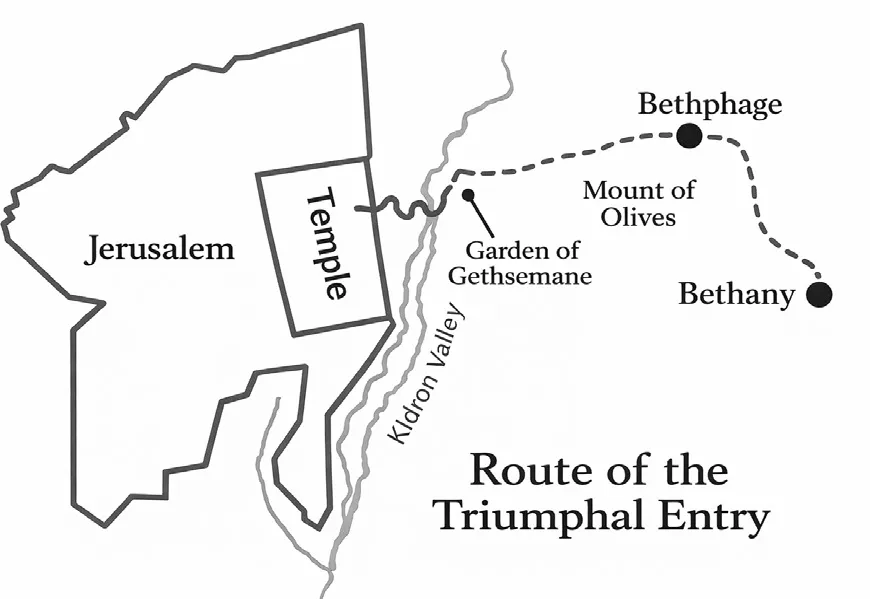
As Jesus approaches Jerusalem for the Passover, large crowds welcome Him with palm branches, shouting, “Hosanna! Blessed is he who comes in the name of the Lord, even the King of Israel!” (v. 13).
The joyful recognition of Jesus identifies Him as the Messiah and fulfils Zech 9:9, portraying Him as a humble King who comes in peace rather than with military might. While the crowd acknowledges His messianic role, they anticipate political liberation, and the Pharisees respond with unease, fearing that His influence might threaten their authority.
The Approaching of the Greeks (12:20–36a)
Section titled “The Approaching of the Greeks (12:20–36a)”Some Greeks Seek Jesus
20 Now among those who went up to worship at the feast were some Greeks. 21 So these came to Philip, who was from Bethsaida in Galilee, and asked him, “Sir, we wish to see Jesus.” 22 Philip went and told Andrew; Andrew and Philip went and told Jesus. 23 And Jesus answered them, “The hour has come for the Son of Man to be glorified. 24 Truly, truly, I say to you, unless a grain of wheat falls into the earth and dies, it remains alone; but if it dies, it bears much fruit. 25 Whoever loves his life loses it, and whoever hates his life in this world will keep it for eternal life. 26 If anyone serves me, he must follow me; and where I am, there will my servant be also. If anyone serves me, the Father will honor him.”
The Third Monologue: “The Hour has Come” (vv. 20–50)
Section titled “The Third Monologue: “The Hour has Come” (vv. 20–50)”In this monologue, Jesus announces that His impending death will glorify God, calls people to believe in Him as the light of the world, and emphasises that faith leads to life, while rejection brings judgment.
Some Greeks Seek Jesus (vv. 20–26)
Section titled “Some Greeks Seek Jesus (vv. 20–26)”During the Passover festival, some Greeks (likely God-fearers drawn to Jewish worship) approach Philip, asking to see Jesus, signalling the widening reach of His mission beyond Israel.
Philip and Andrew bring the request to Jesus. He reveals to them, “The hour has come for the Son of Man to be glorified” (v. 23). This is remarkable; throughout the Gospel up to this point, Jesus has reiterated that His hour had not yet come (cf. 2:4; 8:20). Now, there is a sudden shift: Jesus’ “hour” has come. What is this “hour”? It is the hour of Jesus’ death.
Jesus teaches that His death is necessary, comparing Himself to a grain of wheat that must fall and die to produce fruit (v. 24). True discipleship follows the same principle: those who cling to their lives will lose them, but those who surrender their lives for Christ’s sake will gain eternal life. This underscores the call to costly commitment and spiritual renewal through sacrifice.
The Son of Man Must Be Lifted Up
27 “Now is my soul troubled. And what shall I say? ‘Father, save me from this hour’? But for this purpose I have come to this hour. 28 Father, glorify your name.” Then a voice came from heaven: “I have glorified it, and I will glorify it again.” 29 The crowd that stood there and heard it said that it had thundered. Others said, “An angel has spoken to him.” 30 Jesus answered, “This voice has come for your sake, not mine. 31 Now is the judgment of this world; now will the ruler of this world be cast out. 32 And I, when I am lifted up from the earth, will draw all people to myself.” 33 He said this to show by what kind of death he was going to die. 34 So the crowd answered him, “We have heard from the Law that the Christ remains forever. How can you say that the Son of Man must be lifted up? Who is this Son of Man?” 35 So Jesus said to them, “The light is among you for a little while longer. Walk while you have the light, lest darkness overtake you. The one who walks in the darkness does not know where he is going. 36 While you have the light, believe in the light, that you may become sons of light.”
The Son of Man Must Be Lifted Up (vv. 27–36)
Section titled “The Son of Man Must Be Lifted Up (vv. 27–36)”As Jesus faces His approaching death, He admits, “Now is my soul troubled” (v. 27), yet He resolves to glorify the Father, revealing the connection between suffering, obedience, and divine purpose. He foretells that the Son of Man must be “lifted up” (vv. 32–33), pointing both to His crucifixion and to the manifestation of His glory, so that all who believe may have eternal life. He calls His followers to walk in the light while it lasts (vv. 35–36), warning that rejection leads to judgment, while embracing Him brings transformation.
The Three “Lifted Up” Sayings
Section titled “The Three “Lifted Up” Sayings”In John’s Gospel, three “lifted up” sayings reveal the meaning of Jesus’ death. First, He likens Himself to the bronze serpent lifted by Moses: “And as Moses lifted up the serpent in the wilderness, so must the Son of Man be lifted up, that whoever believes in him may have eternal life” (3:14–15), showing that His death brings life. Later, He explains that being lifted up will reveal His identity: “When you have lifted up the Son of Man, then you will know that I am he” (8:28). Finally, He declares, “When I am lifted up from the earth, I will draw all people to myself” (12:32–33), demonstrating the redemptive power of His sacrifice.
The Unbelief of the Jews (12:36b–50)
Section titled “The Unbelief of the Jews (12:36b–50)”The Unbelief of the People
When Jesus had said these things, he departed and hid himself from them. 37 Though he had done so many signs before them, they still did not believe in him, 38 so that the word spoken by the prophet Isaiah might be fulfilled: “Lord, who has believed what he heard from us, and to whom has the arm of the Lord been revealed?”
39 Therefore they could not believe. For again Isaiah said,
40 “He has blinded their eyes and hardened their heart, lest they see with their eyes, and understand with their heart, and turn, and I would heal them.”
41 Isaiah said these things because he saw his glory and spoke of him. 42 Nevertheless, many even of the authorities believed in him, but for fear of the Pharisees they did not confess it, so that they would not be put out of the synagogue; 43 for they loved the glory that comes from man more than the glory that comes from God.
The Unbelief of the People (vv. 37–43)
Section titled “The Unbelief of the People (vv. 37–43)”Although Jesus performed many signs, including raising Lazarus, most people did not believe in Him, fulfilling Isaiah’s prophecy of hardened hearts and spiritual blindness (vv. 37–41). Their unbelief was not due to a lack of evidence but arose from pride, fear, and the desire for human approval.
Many believed privately yet refused to confess Him openly, fearing social and religious repercussions (v. 42). The religious leaders, in particular, valued honour from others over obedience to God (v. 43). John highlights a recurring theme: divine revelation exposes the true condition of the heart, and Jesus’ glory and signs provoke both conviction and rejection, demonstrating that faith requires courage and alignment with God rather than conformity to human opinion.
Jesus Came to Save the World
44 And Jesus cried out and said, “Whoever believes in me, believes not in me but in him who sent me. 45 And whoever sees me sees him who sent me. 46 I have come into the world as light, so that whoever believes in me may not remain in darkness. 47 If anyone hears my words and does not keep them, I do not judge him; for I did not come to judge the world but to save the world. 48 The one who rejects me and does not receive my words has a judge; the word that I have spoken will judge him on the last day. 49 For I have not spoken on my own authority, but the Father who sent me has himself given me a commandment—what to say and what to speak. 50 And I know that his commandment is eternal life. What I say, therefore, I say as the Father has told me.”
Jesus Came to Save the World (vv. 44–50)
Section titled “Jesus Came to Save the World (vv. 44–50)”Jesus declares that believing in Him is responding to the Father who sent Him, recognising divine truth rather than merely hearing words (vv. 44–45).
He came as light into the world to save, not to condemn, yet rejection brings judgment and darkness, while belief brings life (v. 46).
His words reveal the Father’s will and call for obedience, linking faith to action (vv. 47–48). Though His mission offers salvation to all, unbelief exposes the hardness of the human heart (vv. 39–40). This passage contrasts light and darkness, showing that acceptance of Jesus leads to eternal life, whereas rejection brings judgment. Faith in Him aligns believers with God’s saving purpose and eternal truth.
Belief and Unbelief in the Book of Signs
Section titled “Belief and Unbelief in the Book of Signs”The theme of belief and unbelief runs throughout John 1–12. Throughout the narrative, each sign performed by Jesus reveals His identity and calls for a response. John presents a consistent pattern in the seven signs. Each sign discloses Jesus’ identity, the revelation presents the truth, and the people are compelled to choose whether to believe in Him or reject Him. Thus, the pattern unfolds as: Sign → Revelation → Decision.
| Sign | Passage | Belief Response |
|---|---|---|
| Water to wine | John 2 | Disciples believe |
| Official's son healed | John 4 | Household believes |
| Lame man healed | John 5 | Opposition begins |
| Feeding 5000 | John 6 | Disciples reaffirm belief |
| Walking on water | John 6 | Faith deepens |
| Man born blind healed | John 9 | Personal confession of faith |
| Lazarus raised | John 11 | Many believe |
The Pattern of the Seven Signs
The Water Motif in the Book of Signs
Section titled “The Water Motif in the Book of Signs”In the Gospel of John, water functions as a significant literary and theological motif. It appears repeatedly in the first half of the Gospel (John 1–12) and finds its fullest expression in the closing scenes of Jesus’ death and resurrection (John 19–20). Throughout these narratives, water symbolizes life, cleansing, faith, and the life-giving work of the Holy Spirit.
| Passage | Use of Water | Meaning |
|---|---|---|
| 2:1–11 | Water into wine | Transformative life in Christ |
| 3:5 | Born of water and Spirit | Spiritual cleansing and new birth |
| 4:14 | Living water to the Samaritan woman | Eternal life that provides spiritual satisfaction through faith |
| 5:1–9 | Pool of Bethesda | Healing through Christ |
| 6:16–21 | Sea of Galilee | Christ's authority over creation |
| 7:37–39 | Rivers of living water | The Holy Spirit flows from believers |
| 9:1–7 | Pool of Siloam | Obedience and faith leading to sight and spiritual illumination |
The Water Motif in John 1–12
Preaching and Teaching the Word
Section titled “Preaching and Teaching the Word”A Discipleship Model (12:1–11)
John 12:1–11 presents three complementary models of discipleship in Bethany. Martha demonstrates faithful service, Mary expresses devoted love by anointing Jesus, and Lazarus bears witness to the new life Christ gives. Together, they illustrate that true discipleship flows from Christ’s grace, encompassing service, heartfelt devotion, and a transformative testimony of faith.
Wiping Feet (12:1–3)
Mary anoints Jesus’ feet (John 12:3), and later Jesus washes His disciples’ feet (John 13:5). John uses the same Greek word for to wipe in both accounts, linking Mary’s act to Jesus’ own action. Both narratives highlight expressions of love: Mary demonstrates a disciple’s love for Jesus, while Jesus reveals God’s love for us. Through His example with the towel and basin, He teaches that honouring God involves serving others, showing that genuine love for God is lived out in humble, selfless care for one another.
Extravagant Love (12:1–8)
Mary demonstrates the beauty of extravagant love by anointing Jesus Christ with costly perfume. Her act in Bethany illustrates that true discipleship involves wholehearted devotion and sacrificial love, marking the believer’s response to Christ’s grace and worth. This extravagant worship becomes a model of genuine faith and commitment.
The Triumphal Entry (12:12–19)
Approach a sermon on the triumphal entry of Jesus Christ into Jerusalem by highlighting His humility, the fulfilment of prophecy, and the crowd’s mixed understanding. Emphasise that true triumph points to the cross and resurrection, where God’s kingdom is established. Invite listeners to respond in faith and discipleship rather than mere outward praise.